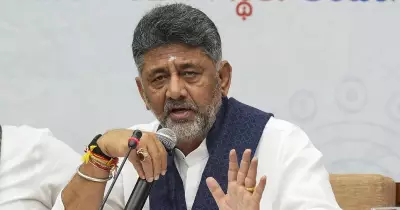
In a firm stance against rising communal narratives, Communist Party of India (Marxist) state secretary M V Govindan declared the party's commitment to relentlessly expose attempts by political and communal forces to misrepresent criticism. The senior leader made these remarks during a news conference in Thiruvananthapuram on Saturday.
Gandhi Jayanti to Highlight Anti-Communal Stand
Govindan revealed that the CPM will observe Gandhi Jayanti on January 30 with elaborate programmes. This initiative aims to draw greater public attention to what he termed an unfounded campaign by certain communal forces and political parties. The party seeks to clarify that its criticism is directed at extremist organizations, not religious communities.
Historical Context and Political Contradictions
Addressing the controversy surrounding Jamaat-e-Islami, Govindan recalled that it was the previous Congress-led United Democratic Front (UDF) government under Oommen Chandy that had filed a significant affidavit in the High Court. That affidavit labeled Jamaat-e-Islami as a dangerous organization working towards establishing a Muslim theocratic state, acting against the Indian Constitution's principles. The affidavit had even stated the government's willingness to ban the organization if warranted.

"IUML's P K Kunhalikutty was the second-in-command in the Chandy government, and Ramesh Chennithala was the home minister. Current opposition leader V D Satheesan was an MLA then," Govindan stated. He accused the present-day Congress and Indian Union Muslim League (IUML) of now "singing paeans to Jamaat," attempting to create a false impression that criticism of the organization equates to criticism of the entire Muslim community.
A Dual Challenge: Minority and Majority Extremism
Govindan extended this argument to the right-wing spectrum, alleging that the Bharatiya Janata Party (BJP) and Sangh Parivar organizations are employing a similar tactic. They are trying to portray the CPM's criticism of the Rashtriya Swayamsevak Sangh (RSS) as an attack on Hindu religious believers.
"Society should understand that criticism against religious fundamentalists is not against religion," he asserted. To drive his point, Govindan invoked the legacy of Mahatma Gandhi, calling him a true believer, and contrasted him with Nathuram Godse, whom he labeled a religious fanatic. "How can one argue that criticism against a religious fanatic is criticism against religion?" he questioned.
The CPM leader pledged that his party would continue to expose this contradiction and work among the people to oppose both minority and majority communal extremists. He also defended the right to discuss past communal violence, specifically referencing the Marad riots that occurred during the UDF rule. "Why should there be no reference to Marad? Both RSS and Jamaat are poison. Their ideologies are dangerous to society," Govindan said.
Internal Party Statements and a Unified Stand
When asked about senior party functionary A K Balan's recent statement suggesting that Jamaat-e-Islami would rule the state home department if the UDF returned to power, Govindan declined to comment directly. He stated that he neither needed to endorse nor criticize the remarks of a senior leader like Balan, emphasizing that the CPM's consistent anti-communal stand is well-known. Balan, earlier in the day, had also refused to apologize for his comments despite demands.
The CPM's clear positioning aims to distinguish between political criticism of organized communal groups and faith itself, a line it claims its political opponents are deliberately blurring for electoral gain.