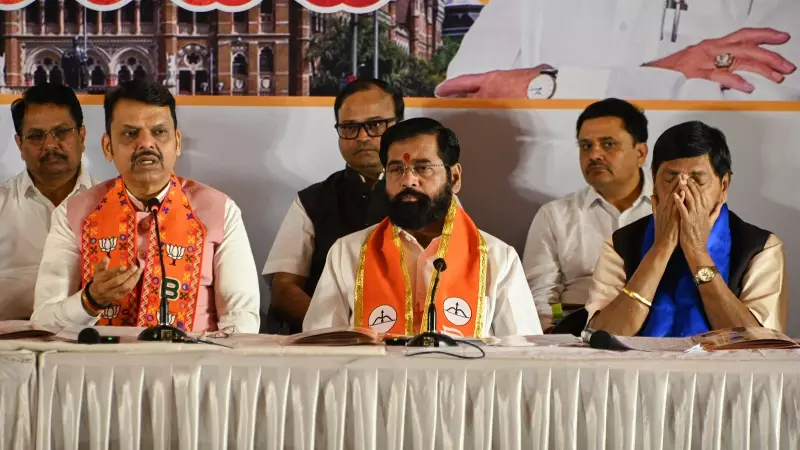
The Bharatiya Janata Party has achieved a remarkable political milestone in Maharashtra's urban landscape. Recent municipal corporation election results reveal the party now holds nearly half of all corporator positions across the state. This development signals a significant consolidation of urban political power in favor of the BJP.
Unprecedented Numbers in Urban Governance
With 1,425 corporators elected under its banner, the BJP now accounts for almost fifty percent of Maharashtra's 2,869 municipal corporation representatives. This represents the party's strongest civic performance to date in the state. The scale of this achievement becomes even more impressive when examined over time.
In the previous municipal election cycle, the BJP had secured 1,099 corporator positions. Going back further to the cycle before that, the party's tally stood at just 320 seats. This steady expansion demonstrates how decisively the BJP has consolidated its position in Maharashtra's cities and large towns over the past decade.

Absolute Majorities Across Key Urban Centers
The BJP currently enjoys absolute majority control in thirteen of Maharashtra's twenty-nine municipal corporations. These include significant urban centers such as Navi Mumbai, Mira-Bhayandar, Panvel, Nashik, Dhule, Jalgaon, Pune, Pimpri-Chinchwad, Solapur, Nanded, Nagpur, Ichalkaranji and Jalna.
Beyond these strongholds, the party has emerged as the single largest political force in six additional corporations. This includes Mumbai, Ulhasnagar, Amravati, Akola, Chhatrapati Sambhajinagar and Sangli. While the BJP had also secured absolute majorities in thirteen corporations during the previous election round, current results show sharper and more widespread consolidation.
Historical Context and Political Shifts
The roots of this urban dominance trace back to the BJP's 2014 Lok Sabha breakthrough, which fundamentally reshaped Maharashtra's political landscape. That national victory marked a distinct shift in urban voting patterns across the state. Traditional political loyalties weakened significantly, positioning the BJP as the default party of power in Maharashtra's cities.
Subsequent Assembly elections and civic polls have consistently reinforced this trend. The party has successfully expanded its footprint into newer urban centers while simultaneously strengthening its hold in existing strongholds. This dual strategy has produced the current landscape of near-total urban dominance.
Opposition and Ally Performance Contrast
Among the BJP's political rivals and allies, the picture appears considerably more fragmented. The Eknath Shinde-led Shiv Sena has emerged as the second-largest political force with 399 corporators. Meanwhile, the Uddhav Thackeray-led Shiv Sena (UBT) has secured 155 seats.
When considered together, the undivided Shiv Sena had won 489 corporator positions in the previous election cycle. This indicates a noticeable decline in the party's overall civic strength following its political split. The division has clearly impacted the party's municipal election performance.
The Congress party, once a significant player in urban local bodies across Maharashtra, has been reduced to 324 corporators. This represents a decline from 439 seats in previous elections. The party has managed to secure an absolute majority only in Latur, highlighting its shrinking influence in Maharashtra's urban centers.
A similar story has unfolded within the Nationalist Congress Party. The Ajit Pawar-led NCP faction has won 169 seats, while the Sharad Pawar-led NCP (SP) faction has been pushed to the political margins with just 36 corporators. By comparison, the undivided NCP had secured 294 seats in the earlier election cycle.
Broader Political Implications
These election results strongly suggest that the BJP's political rise has come at the expense of both its opponents and its allies. The party's expanding urban footprint reflects a fundamental realignment of political power in Maharashtra's municipal governance structures.
The consolidation of urban political control provides the BJP with significant influence over key municipal decisions, infrastructure projects, and local governance mechanisms across Maharashtra. This positions the party advantageously for future political contests at both local and state levels.

As urban populations continue to grow across Maharashtra, control of municipal corporations becomes increasingly significant for political parties. The BJP's current dominance suggests it has successfully positioned itself as the preferred political choice in the state's rapidly urbanizing landscape.