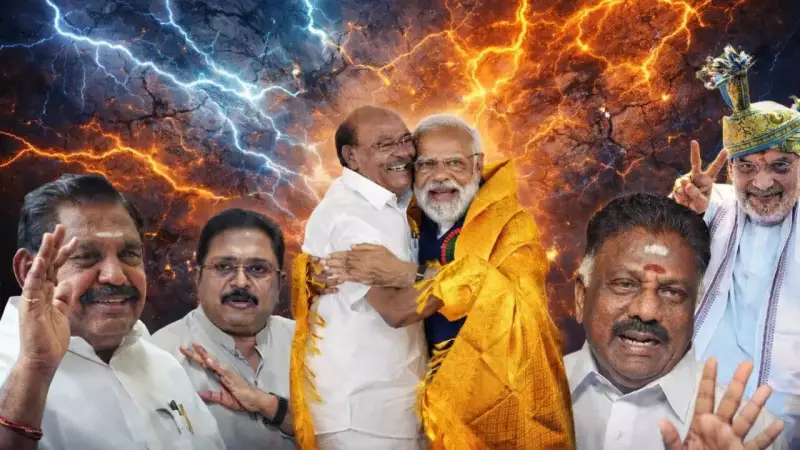
A high-stakes, late-night meeting in Delhi last week between Union Home Minister Amit Shah and AIADMK general secretary Edappadi K. Palaniswami (EPS) has laid bare the growing tensions within Tamil Nadu's opposition alliance. While framed as routine discussions for the 2026 Tamil Nadu Assembly elections, the talks revealed a significant push by the Bharatiya Janata Party (BJP) for greater control, threatening the unity of the National Democratic Alliance (NDA) against the ruling Dravida Munnetra Kazhagam (DMK).
The Core Demand: A Share of Power
At the heart of the discord is a BJP demand that breaks from Tamil Nadu's political conventions. The party is reportedly seeking a formal, pre-election assurance of power-sharing from the AIADMK. This includes a claim for at least three cabinet berths in the event that an AIADMK-led NDA forms the next government in 2026.
For a state with a strong history of Dravidian assertion and regional autonomy, such an explicit demand for a stake in governance before votes are cast is rare. The AIADMK's reaction has been one of wariness and resistance, reflecting the BJP's still-limited grassroots clout in the southern state. This move is part of the BJP's calculated strategy to signal to its cadres and voters that it aims to be a governing stakeholder, not just a supporting ally.

BJP's Southern Calculus and a Crowded Political Field
For the BJP, Tamil Nadu remains its most formidable electoral challenge. Despite increased vote share and organizational work, converting presence into seats has been difficult. The alliance with the AIADMK is, therefore, viewed in Delhi as the primary vehicle for relevance. Reflecting this urgency, the BJP, under Amit Shah's curation, is pushing to contest around 56 of the state's 234 assembly seats through itself and its smaller allies.
This push coincides with efforts to rebuild a broader NDA by wooing back former allies and breakaway factions. The goal is to consolidate the anti-DMK vote and prevent splitting that could hand the DMK another advantage. However, this centralized approach risks reviving the potent narrative of "Delhi control," which could become a liability for the AIADMK.
The political landscape is unusually fluid. The DMK defends its record amid whispers of unease with ally Congress. Meanwhile, actor Vijay's new party, the Tamilaga Vettri Kazhagam (TVK), has entered as a wildcard, appealing to youth and disillusioned voters. The result is a potential multi-cornered contest where perception is as crucial as arithmetic.
AIADMK's Survival Struggle and Internal Fractures
The alliance pressure comes at a critical time for the AIADMK. Since the death of its iconic leader J. Jayalalithaa, the party has struggled to regain dominance. After the 2021 assembly defeat, where the AIADMK-led alliance won 75 seats (AIADMK 66) against the DMK-led front's 159, EPS moved to consolidate his sole authority, pushing out rival O. Panneerselvam (OPS).
This internal split created a dilemma for the BJP. While it views OPS as more approachable, it cannot ignore EPS's control over the party. EPS's reluctance to commit to power-sharing or re-induct expelled leaders like TTV Dhinakaran stems from a desire to protect his authority and the AIADMK's regional identity. He sees these elements as threats to internal cohesion, while the BJP views them as necessary to consolidate specific caste votes and prevent further fragmentation of the opposition vote.
The re-entry of the Pattali Makkal Katchi (PMK) adds another layer. While it brings the Vanniyar community vote in northern Tamil Nadu, a public rift between leader Anbumani Ramadoss and founder S. Ramadoss has weakened the party's internal unity, making it an unreliable bloc.
The Road to 2026: Perception, Pacts, and Uncertainty
Recent electoral history underscores the high stakes. In 2016, a narrow vote share difference gave the AIADMK 136 seats. In 2021, a broader coalition propelled the DMK to power. Alliances are decisive in Tamil Nadu's first-past-the-post system.

As 2026 approaches, the BJP bets that a reconstituted NDA with clear power-sharing signals can be a viable alternative. The AIADMK walks a tightrope, balancing alliance demands with its need for autonomy. The DMK focuses on stability and governance, while the TVK's untested potential looms large.
The familiar DMK vs. AIADMK binary is evolving into a more complex contest shaped by national ambitions, regional identity, and new voter aspirations. Whether the NDA's current tensions lead to a stronger front or expose fatal contradictions will become clear only when campaigns take shape. For now, Tamil Nadu's path to power remains as unpredictable as ever, decided behind closed doors and in the arena of public perception.