Bengaluru Legislature Session Erupts in Unprecedented Chaos
The joint session of the Karnataka legislature in Bengaluru on Thursday descended into unprecedented chaos and high drama following Governor Thaawar Chand Gehlot's decision to conclude his customary address in merely two lines before walking out of the House. The governor's abrupt departure triggered immediate protests from opposition legislators, setting the stage for a physical confrontation that has raised serious questions about parliamentary decorum and constitutional propriety.
Governor's Truncated Address Sparks Immediate Protests
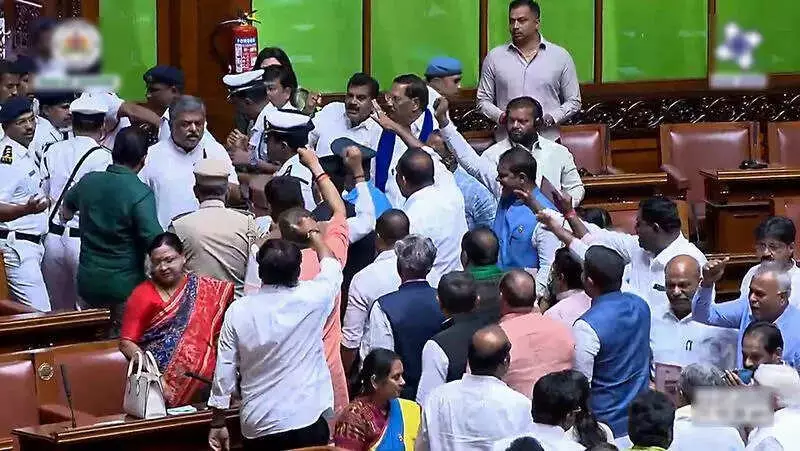
As Governor Gehlot began to make his exit without reading the full speech prepared by the state government, senior Congress MLC BK Hariprasad attempted to block his path and urged him to complete the constitutional address. Marshals quickly intervened to clear the way for the governor, leading to a heated confrontation that turned physical. Eyewitness accounts describe how Hariprasad refused to move aside, resulting in marshals forcibly escorting the legislator out of the chamber.
The scuffle became so intense that Hariprasad's kurta tore during the jostling, leaving the senior legislator standing alone in the House and lobby area in his torn attire before requesting his aides to arrange for a change of clothes. This dramatic visual quickly became symbolic of the escalating tensions within the legislative assembly.

Political Reactions and Accusations Fly
The incident immediately polarized political reactions along party lines. Congress legislators raised loud slogans against the governor and condemned what they described as the excessive conduct of the marshals. Displaying his torn clothes to reporters afterward, Hariprasad made a powerful statement: "This is how a senior legislator is punished for requesting the governor to follow the Constitution. The office of the governor is being run like a political agent, and marshals are being used as bouncers to silence voices of people's representatives."
Chief Minister Siddaramaiah and his deputy DK Shivakumar strongly criticized the incident, with Siddaramaiah stating: "The governor walking out was an insult, but the manner in which security personnel manhandled a senior member like Hariprasad is a new low for our legislature." The Congress party indicated it would move a privilege motion over the conduct of security staff, further escalating the constitutional crisis.
BJP Defends Governor's Actions
Meanwhile, the opposition Bharatiya Janata Party staunchly defended both the governor and the conduct of the marshals. In a social media post, the BJP asserted that the governor's post represents a constitutional office and that respecting the governor amounts to respecting the Constitution itself. The party alleged that Hariprasad had ignored this fundamental principle and shouted slogans "like a local goon," behavior they described as highly condemnable while demanding his immediate suspension from the House.
Opposition leader R Ashoka reinforced this position, stating: "The Constitution, and any sign of disrespect toward the office is an insult to our constitutional values. The disruptive, rowdy-like behavior inside the House violated all parliamentary norms and is utterly unacceptable."
Conflicting Accounts and Viral Video Evidence
Conflicting narratives emerged about how exactly Hariprasad's clothes were torn. While the Congress MLC alleged that BJP members were responsible for damaging his attire, a video circulating on social media appears to show marshals pulling him aside to prevent him from moving forward, with his clothes tearing during the ensuing fracas. The same video footage also captures Congress members Ivan D'Souza, Sharath Bachegowda, Pradeep Eshwar, and HC Balakrishna raising slogans during the chaotic moments.
The uproar became so disruptive that legislative proceedings had to be adjourned, bringing official business to a complete halt. This incident represents one of the most dramatic confrontations in recent Karnataka legislative history, highlighting deepening political divisions and raising fundamental questions about the relationship between constitutional offices and elected representatives.

The controversy has sparked broader discussions about gubernatorial powers, legislative decorum, and the appropriate role of security personnel within parliamentary settings. As political tensions continue to simmer, all eyes remain on how this constitutional impasse will be resolved and what lasting impact it might have on Karnataka's political landscape.