In a significant development for Telangana's political landscape, the Backward Classes (BC) community is poised to receive a substantially larger share of reservations in the upcoming municipal elections in Hyderabad and across the state. The quota for BCs is expected to be increased to 34 per cent, a sharp rise from the approximately 20 per cent provision in the recently concluded gram panchayat polls.
Why the BC Quota is Higher in Urban Areas
The rationale behind the higher reservation percentage for Backward Classes in urban local body elections stems from demographic distribution. The population of Scheduled Tribes (STs) and Scheduled Castes (SCs) is comparatively lower in urban regions than in rural areas. As per the existing rules, reservations for SCs and STs are fixed first, based on their population proportion. The BC quota is determined from the remaining seats. This mechanism results in a larger available share for BCs in cities and municipalities.
This contrasts with the gram panchayat elections, where the BC quota was around 20 per cent. Interestingly, despite this lower official quota, BC candidates, backed actively by political parties, managed to win close to 50 per cent of the sarpanch posts, including victories in general or unreserved categories.
Election Timeline and Preparations
The state government is keen on completing the municipal election process before the intermediate examinations, which are scheduled to begin on February 25. The SSC examinations will follow in March, alongside the assembly budget session, creating a tight window. Sources indicate that the polls may be conducted in one or two phases to expedite the process.
On the administrative front, the municipal administration department has formally requested the government to release ₹85 crore to fund the election proceedings. A critical milestone will be the publication of the final voters' list on January 10. This list will encompass nearly 3,000 municipal divisions across 117 municipalities and six municipal corporations that are scheduled to go to the polls.
Demand for Clarity on 42% Quota
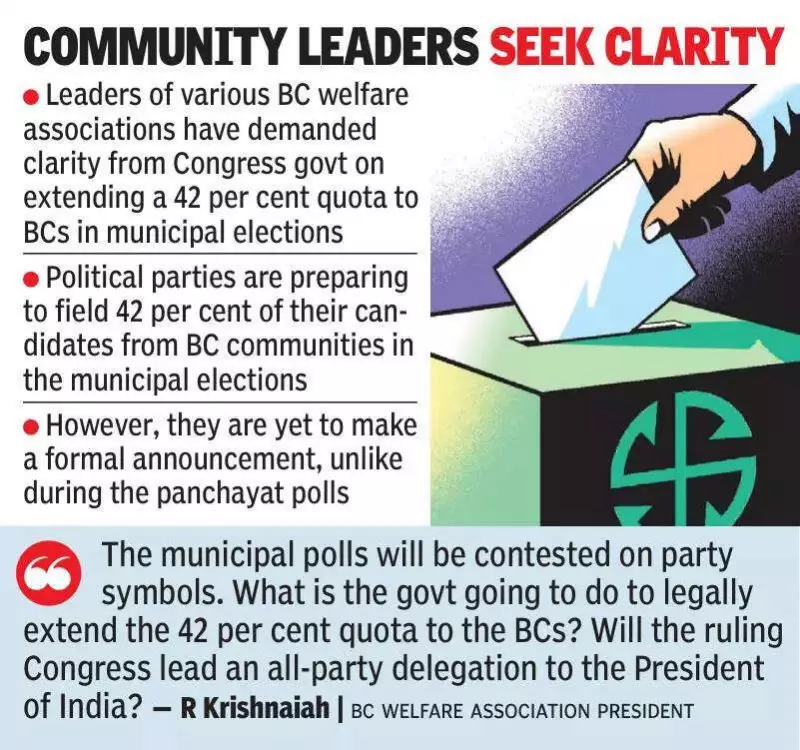
Meanwhile, leaders from various BC welfare associations have raised demands for clarity from the Congress-led state government. They are pushing for the extension of a 42 per cent reservation quota for BCs in the municipal elections, a figure that has become a point of political contention.
R Krishnaiah, the national president of a BC welfare association, highlighted a key difference between the two tiers of elections. "The panchayat elections were fought on a non-political party basis. But the municipal elections will be contested on party symbols. What is the govt going to do to legally extend the 42 per cent quota to the BCs? Will the ruling Congress lead an all-party delegation to the president of India," he questioned.
Reports suggest that political parties are internally preparing to field about 42 per cent of their candidates from BC communities. However, unlike during the panchayat polls, no formal announcement to this effect has been made yet, leaving the final reservation structure a closely watched aspect of the pre-poll preparations.