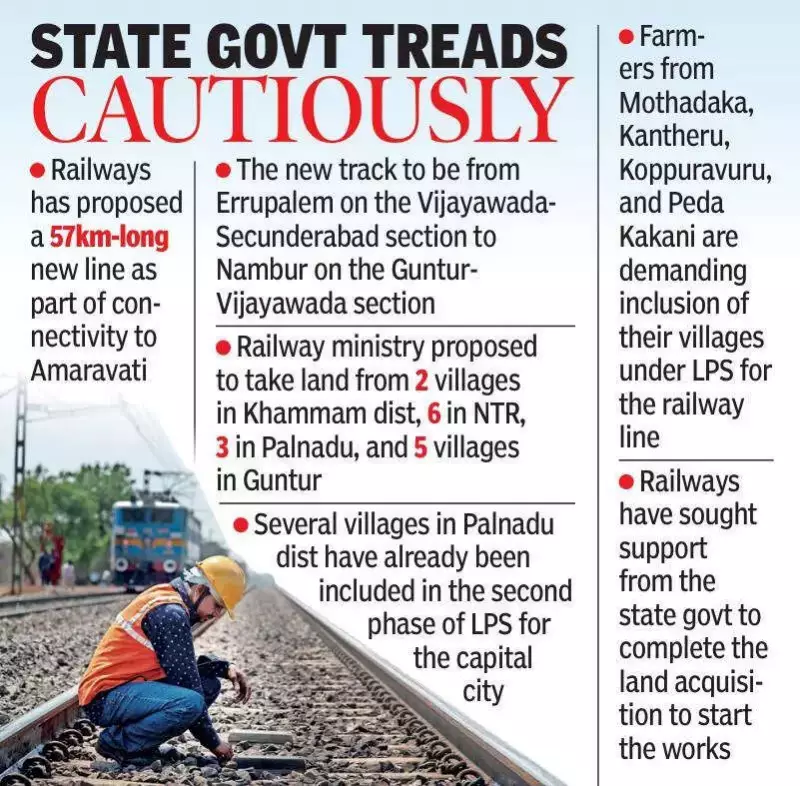
Railway authorities in Andhra Pradesh are encountering significant resistance from farmers in multiple villages along the proposed Amaravati rail line route. The farmers are vehemently opposing the acquisition of their fertile agricultural land through the Right to Fair Compensation and Transparency in Land Acquisition, Rehabilitation and Resettlement (RFCTLARR) Act of 2013. They argue that this method would lead to irreversible livelihood losses and are instead demanding the implementation of a Land Pooling Scheme (LPS) for the project.
Farmers Demand Fair Process, Cite Livelihood Threats
Expressing deep anguish, farmers from villages in Palnadu, Guntur, and NTR districts stated they were taken by surprise when survey notices for land acquisition were issued. They allege that consultations with affected landowners have been grossly inadequate. While acknowledging the need for infrastructure development like the 57km-long new rail line connecting Errupalem to Nambur, they contend it should not come at the cost of their rights and long-term economic security.
Local farmer leaders highlighted that in the core Amaravati capital city area, land pooling was successfully carried out with landowner consent. That model ensured developed plots, annuities, and social infrastructure in return. "We are not against development, but we want a fair and transparent process that protects farmers as their lands are located right in the capital city area," they asserted, demanding the same LPS model be adopted for the railway project instead of compulsory acquisition.

Protests Intensify as Surveys Proceed
Protests have already erupted in several villages, with farmers staging demonstrations and submitting formal representations to district authorities. They have warned of intensifying their resistance in the coming days if railway authorities proceed with the acquisition without addressing their core demand for land pooling.
The issue has drawn in local ruling party leaders and farmer unions, who are urging the state government to hold comprehensive consultations before finalizing the rail alignment and acquisition method. They stress that a development model based on dialogue and mutual consent would prevent public unrest and avoidable project delays.
Government's Cautious Stance and Project Details
As the project is managed by the Union railway ministry, the state government is treading cautiously. Officials point out that opting for the LPS model could be financially burdensome, as it would require the government to spare land from its land bank and spend huge amounts on creating basic infrastructure.
Revenue officials confirmed that preliminary surveys are underway to assess land requirements for the rail project, aimed at improving connectivity to the capital region. They maintained that compensation would be paid as per rules and efforts would be made to minimize displacement. However, farmers counter that monetary compensation alone cannot replace productive agricultural land that supports entire families.
According to the proposed plan, land is required from:
- 2 villages in Khammam district (Telangana)
- 6 villages in NTR district
- 3 villages in Palnadu district
- 5 villages in Guntur district
Notably, several villages in Palnadu district have already been included in the second phase of LPS for the capital city. Farmers from villages like Mothadaka, Kantheru, Koppuravuru, and Peda Kakani are now demanding the inclusion of their villages under LPS for the railway line as well. The railways have formally sought support from the state government to resolve the land acquisition impasse and commence work on the prestigious project.