Ahmedabad Elections Bring Focus to Critical Drainage Infrastructure Gap
As the Ahmedabad Municipal Corporation (AMC) prepares for crucial elections with over 38 lakh voters set to elect 192 councillors, a significant civic deficiency continues to overshadow the city's impressive growth narrative. The absence of a comprehensive drainage network in nearly 10% of Ahmedabad's areas has emerged as a pressing concern that could influence voter sentiment and urban planning priorities.
Official Claims Versus Ground Reality
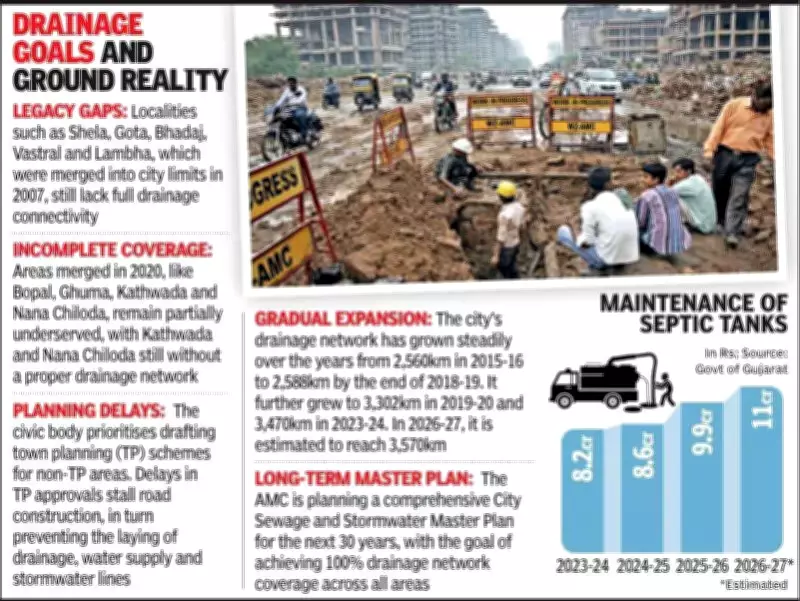
While the AMC officially maintains that "98% of the city is covered by a drainage network", multiple sources and extensive ground reports reveal a different picture. Several rapidly developing peripheral localities remain completely outside the municipal drainage system's reach. These include Bhadaj, Shela, Sarkhej, Gota, Ognaj, Kathwada, Lambha, and Vastral—areas experiencing substantial residential and commercial growth.
Residents in these uncovered zones depend heavily on septic tanks and soak pits for wastewater management, creating significant public health risks and environmental challenges. This infrastructure gap highlights the disconnect between urban expansion and basic civic service provision in one of India's fastest-growing metropolitan regions.

Infrastructure Expansion Fails to Match Urban Growth
Official data reveals that Ahmedabad currently operates a 3,570-kilometer-long drainage network, representing substantial growth from the 2,560 kilometers available in 2015-16. The city generates approximately 1,320 million liters per day (MLD) of sewage, supported by 75 pumping stations and 18 sewage treatment plants with a combined handling capacity of 1,367 MLD.
Despite these infrastructure investments, development has not kept pace with rapid urbanization, particularly in newly merged zones and developing peripheries. The absence of underground drainage has resulted in over 20,000 septic tanks operating across the city, with housing societies in uncovered areas relying exclusively on soak pits for wastewater disposal.
Civic officials acknowledge that development permissions are frequently granted in these areas based on temporary wastewater solutions, leading to residential clusters emerging before proper drainage infrastructure is established. The AMC spends an estimated Rs 8–10 crore annually on septic tank maintenance alone, highlighting the financial implications of this infrastructure deficit.
Environmental and Health Implications
The drainage gap has created serious environmental concerns throughout Ahmedabad. An AMC official, speaking on condition of anonymity, revealed that illegal sewage discharge into lakes is partly attributable to the absence of underground networks.
"Stormwater lines were originally connected to lakes in certain areas, but unauthorized sewage connections have significantly worsened pollution levels," the official explained. "The corporation has now initiated bioremediation efforts in five lakes to address this growing environmental challenge."
Peripheral Wards Bear the Brunt
The infrastructure deficiency is particularly acute in large peripheral wards where urban expansion has been most rapid. Former corporators point to long-standing neglect and planning delays that have left residents without basic services.
"Lambha ward is the largest in Ahmedabad, yet nearly 60% of it lacks drainage, water, and stormwater networks," said Kalu Bharwad, former councillor of Lambha ward. "Even after being merged into the municipal corporation in 2007, residents still depend on 1,500–2,000 septic tanks and soak pits. Development is happening at a rapid pace, but basic infrastructure remains missing."
Haji Cementwala, former councillor of Maktampura ward, added: "Approximately 20% of Maktampura ward still has no drainage network. In areas like Gyaspur, people rely entirely on septic tanks, and even neighboring Sarkhej faces similar challenges. Older societies have been completely excluded from the drainage grid, creating inequitable service distribution."

Elections and Future Planning
With the AMC proposing a comprehensive 30-year City Sewage and Storm Water Master Plan aimed at achieving 100% coverage, drainage infrastructure is likely to emerge as a key voter concern during the upcoming elections. This is particularly true in the city's expanding fringes where urban growth continues to outpace basic civic service provision.
The elections present an opportunity for residents to voice their concerns about infrastructure gaps that affect daily life, public health, and environmental sustainability. As Ahmedabad continues its growth trajectory, balancing development with essential civic infrastructure will remain a critical challenge for municipal authorities and elected representatives alike.