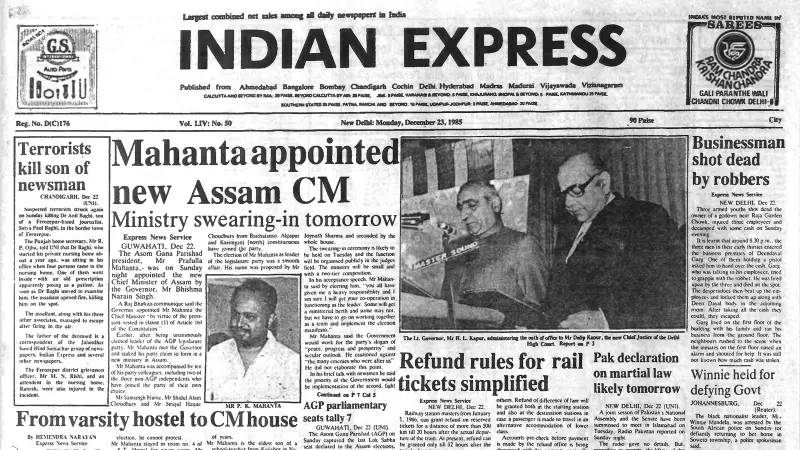
December 23, 1985, was a day of significant political developments across South Asia, with events in Assam, Pakistan, and on the international diplomatic stage capturing headlines. The front page of The Indian Express from that date chronicled the appointment of a new chief minister in Assam, potential political liberalization in Pakistan, and a major Soviet proposal for regional security.
A New Era Begins in Assam: Prafulla Mahanta Takes Charge
In a landmark moment for Assam politics, Prafulla Mahanta was appointed as the state's new Chief Minister. The appointment was made official by the Governor, Bhishma Narain Singh, at Raj Bhawan. The Governor's communique cited Article 164(1) of the Constitution as the basis for the decision.
This formal appointment followed Mahanta's unanimous election as the leader of the Asom Gana Parishad (AGP) legislature party. After his election, Mahanta promptly met with the Governor to stake his party's claim to form the government, marking a decisive turn in the state's political landscape following the Assam Accord.

In a related electoral triumph, the AGP also secured its seventh Lok Sabha seat from Assam. The party's candidate, Gokul Saikia, won the Lakhimpur constituency in a fiercely contested ten-cornered fight. This victory capped the AGP's performance, having contested 10 out of the state's 14 parliamentary seats.
Pakistan's Political Crossroads: Martial Law Under Review
Across the border, Pakistan stood at a potential political turning point. Radio Pakistan reported that a joint session of the country's National Assembly and Senate had been summoned to meet in Islamabad. While the official announcement provided scant details, widespread reports indicated that the session might herald the lifting of the eight-year-old martial law imposed by President Zia-ul-Haq.
In a separate development, the Pakistan cabinet was briefed on the recent talks between President Zia-ul-Haq and Indian Prime Minister Rajiv Gandhi, which had taken place in New Delhi. This indicated a period of diplomatic engagement between the two nations amidst the internal political shifts in Pakistan.
The Soviet Union's Vision for Asian Security
On the international front, the Soviet Union elaborated a comprehensive concept for Asian security. This proposal, which had received a brief mention in the joint communique after Prime Minister Rajiv Gandhi's visit to Moscow in May 1985, was now fleshed out with greater detail.
The Soviet plan advocated for a renunciation of support for subversive and terrorist groups and promoted the creation of nuclear-weapon-free zones. It strategically wove together several established diplomatic principles:
- The Panch Shila (Five Principles of Peaceful Coexistence) originally formulated by India and China.
- The Ten Principles adopted at the historic 1955 Bandung Conference.
- Various initiatives previously advanced by the Soviet Union and other states in the Asian region.
This framework represented a significant diplomatic effort to shape a collective security architecture in Asia during the Cold War era.
The events of December 23, 1985, collectively painted a picture of a region in flux—from the assertion of a regional mandate in Assam and potential democratic restoration in Pakistan to grand geopolitical designs for continental stability. Each development carried profound implications for the future trajectory of domestic politics and international relations in the years to follow.