Telangana Women Transform Rangoli Art into Poverty Mapping Tool
As the vibrant colors of Sankranti rangoli fade from courtyards across Telangana, women in rural villages are giving this traditional art form a powerful new purpose. They are now using the same bright hues to create detailed social maps of their communities, specifically designed to identify the poorest households. This marks a significant shift in how poverty documentation happens at the grassroots level.
From Festival Decoration to Data Collection
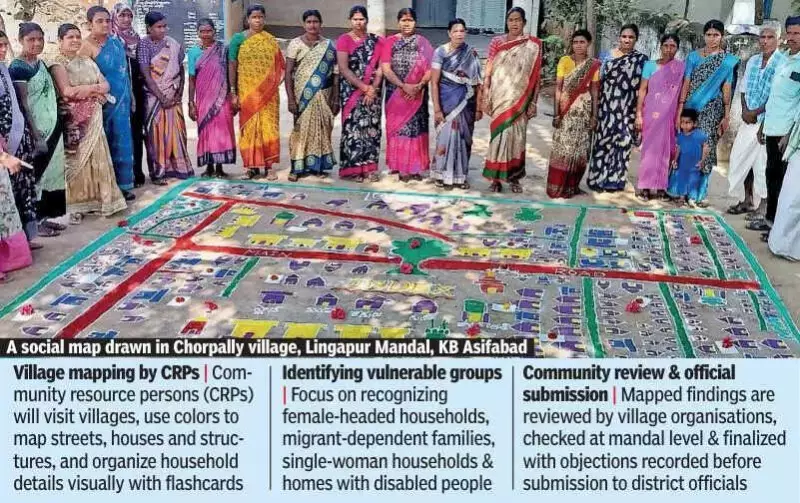
Trained community resource persons, drawn from local self-help groups, are leading this innovative exercise. These women, equipped with new skills through training from the Society for Elimination of Rural Poverty (SERP), are transforming cultural practice into practical data collection. Using colorful powders, they sketch comprehensive village layouts showing streets, houses, community buildings, and other important structures.
What makes this approach particularly effective is its participatory nature. After the initial mapping and identification of the poorest families, the findings undergo public scrutiny. Villagers actively participate by raising objections or flagging households they believe have been incorrectly included or excluded from the list. This community validation process ensures greater accuracy and local ownership of the results.

Accelerating Welfare Delivery
Government sources reveal that traditional survey methods would have taken nearly four years to complete across Telangana's villages. The state government, however, wants to implement special measures for the poorest residents much sooner. By leveraging community networks and local knowledge, this participatory approach significantly speeds up the identification process.
Officials believe this method provides a sharper, more accurate picture of deprivation on the ground. The approach aims to reduce exclusion errors that often occur in top-down surveys. By anchoring the exercise in existing community structures, the state taps into intimate local knowledge that external surveyors might miss.
Building Better Policy Foundations
This innovative poverty mapping initiative serves multiple purposes beyond just identification. It creates a stronger foundation for welfare planning and policy interventions. The detailed social maps help officials understand village layouts and community dynamics better.
The process also empowers local women, giving them new skills and a direct role in community development. As they map their own villages, these women gain deeper insights into their communities' needs and challenges. Their active participation ensures that welfare schemes can reach those most in need more effectively.
This blending of traditional art with modern social mapping represents a creative solution to a persistent challenge. It demonstrates how cultural practices can evolve to serve contemporary needs while maintaining their community roots. The initiative shows particular promise for rural areas where conventional data collection methods often face limitations.