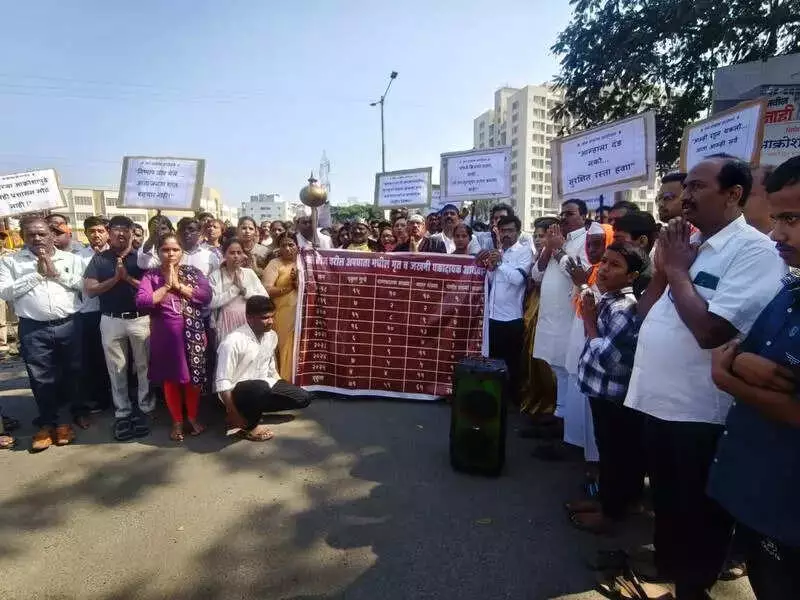
Frustrated citizens of Narhe took to the streets on Sunday, staging a powerful protest march to demand immediate and lasting safety measures for the notoriously dangerous Navale Bridge section of the Pune-Bengaluru highway. The community's anger stems from what they describe as a cycle of temporary fixes from authorities that follow major accidents, leaving commuters in a perpetual state of danger.
A Tragedy That Sparked Outrage
The protest was fueled by a horrific incident on November 13, where a catastrophic chain of events unfolded. A truck lost control and plowed into multiple vehicles near the bridge. The collision was so severe that one car was crushed between two trucks and subsequently caught fire. The accident resulted in eight fatalities and left several others injured, marking another grim chapter for a stretch of road that has witnessed numerous major accidents in recent years.
Temporary Measures and Public Distrust
In response to the public outcry after the November tragedy, the traffic department announced several steps. These included reducing the speed limit to 30 kmph between Swaminarayan Temple and Wadgaon Bridge and adding more rumble strips. These measures were among those proposed in a review meeting chaired by Union minister Murlidhar Mohol.

However, local residents remain deeply skeptical. Rajendra Bobade, a resident, voiced a common sentiment, stating, "Whenever an accident occurs, authorities enforce speed limits, install numerous rumble strips, and announce several steps, but within a month everything goes back to square one until the next tragedy." This pattern has eroded public trust in the administration's commitment to long-term safety.
The Core Issues and Demands for a Permanent Fix
Protesters highlighted deeper, systemic problems that they believe are being ignored. Bobade challenged the National Highways Authority of India (NHAI), which has claimed the steep gradient near Navale Bridge is within permissible standards. "But they never explained why," he said. "Despite meeting those standards, accidents have continued. They must clarify whether the same parameters apply to areas around dense human settlements. If accidents persist despite implementing guidelines, then it is the guidelines that need revision, not the citizens who keep suffering."
Another resident, Nilesh Mankar, criticized the recent speed limit decision, calling it a poorly conceived, temporary measure taken without consulting locals. He argued, "If a speeding truck loses control and other vehicles are crawling at 30 kmph, more vehicles could get caught in the collision, increasing casualties. This doesn't solve the problem." His concerns were validated by Mahendra Naik, who reported that two more accidents had occurred even after the 30 kmph limit was enforced, proving the measure's ineffectiveness.
The protestors are united in their demand for a fundamental, engineering-based solution. They insist that constructing an elevated corridor to reduce the gradient is the only viable long-term answer. "We have been hearing about the elevated corridor for over five years, but the project remained on paper," Bobade lamented. "This reflects how little the administration cares for the people who have died or for those who risk their lives daily on this stretch." Additionally, they blamed the authorities for neglecting service road repairs and failing to act against encroachments, which further complicate the traffic situation.
For families in Narhe, the bridge is a constant source of anxiety. Naik shared, "Our family members have been constantly worried whenever we step out and cross this accident-prone stretch. They call us every now and then to check whether we are safe whenever there is an accident here." The community's march is a desperate plea for their daily commute to be made safe, not just for a few weeks, but permanently.