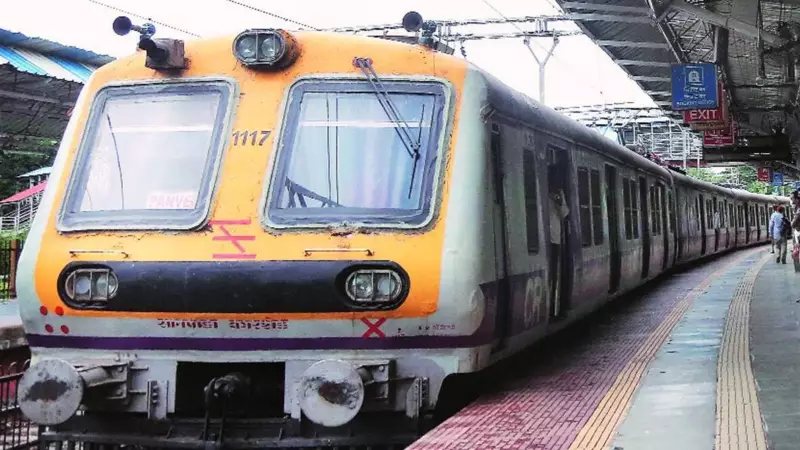
Mumbai's lifeline suburban railway network recorded a marginal decline in commuter fatalities during 2025, yet the grim toll remained staggeringly high, with over 2,200 lives lost. Official data reveals a persistent safety crisis where an average of six individuals died every single day while using the city's rail system.
A Grim Toll: The Numbers Behind the Decline
According to statistics released by the Government Railway Police (GRP), fatal accidents on Mumbai's suburban lines resulted in 2,287 commuter deaths in 2025. This figure represents a 7% decrease from the 2,468 deaths recorded in the previous year, 2024. The number of injured passengers also saw a slight reduction of 5%, falling from 2,697 to 2,554.
However, this year-on-year dip offers little solace, as the data underscores an unrelenting daily tragedy. The concentration of deaths was notably severe in the extended suburban sections, pointing to the acute challenges of rapid urban expansion outpacing transport infrastructure upgrades.

Hotspots and Causes: Where and How Deaths Occur
The GRP data pinpoints specific railway sections as particularly deadly. The Thane section reported the highest number of deaths at 278, followed closely by Kalyan with 266 and Borivali with 244 fatalities. On the Central Railway line, nearly 30% of all deaths occurred on the combined Thane, Dombivli, and Kalyan stretch.
Track crossing remained the single largest cause of death, accounting for 1,063 fatalities or nearly half of all recorded deaths in 2025. The Thane section alone witnessed 144 such tragic incidents. The second major killer was overcrowding, where commuters lost balance and fell from moving trains, leading to 525 deaths. The Kalyan section was the worst-hit for such cases, with 98 reported.
Other significant causes included natural deaths, suicides, electrocution, collisions with railway infrastructure, and fatal falls into platform gaps. Activists and daily commuters repeatedly flagged the Mumbra curve as a critical danger zone. A tragic incident on June 9 exemplified the risks, where five commuters were killed after trains passing in opposite directions came dangerously close in that area.
Safety Debates and Long-Term Solutions
The debate on solutions is intensifying. Passenger advocacy groups and experts attribute the core risk to severe overcrowding and a lack of viable alternative transport, especially for the massive daily influx from the Kalyan-Dombivli-Thane belt.
One proposed intervention is the introduction of automatic doors on non-air-conditioned local train coaches. Dr. Sarosh Mehta, a railway safety activist and former orthopaedic surgeon, cautioned that such a measure requires comprehensive planning. "Automatic doors can help reduce commuter deaths, but only if they are implemented with structural changes that account for severe overcrowding in non-AC coaches," Dr. Mehta stated. "Without redesigning coach layout, ventilation and passenger movement, such measures may fall short."
Railway authorities, in submissions to the Bombay High Court last year, listed several safety measures already undertaken. These include fencing 47 platforms, sealing 204 trespass-prone access points, removing 1,260 encroachments, and installing warning systems at high-risk locations. Longer-term infrastructure projects like the Panvel-Karjat and Airoli-Kalwa corridor upgrades are also in the pipeline.
A senior Central Railway official expressed reservations about automatic doors for non-AC coaches due to challenges faced in multiple trials. The official outlined a longer-term vision: "The longer-term approach is a phased transition to an all–air-conditioned fleet, the 238 new AC locals ordered under MUTP3, with new AC locals expected to be inducted from 2027 through 2031."
While the 2025 data shows a slight improvement, the daily loss of life on Mumbai's railways continues to sound a deafening alarm for systemic, urgent, and effective safety reforms.