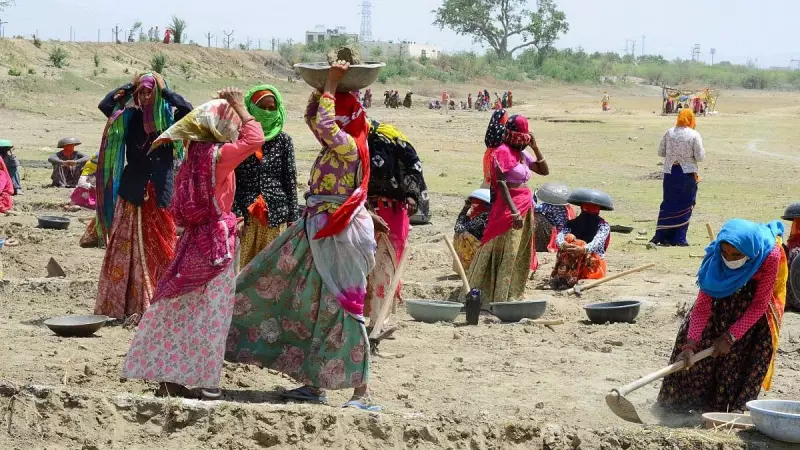
A significant shift is underway in India's social welfare landscape. The government's focus appears to be moving from the employment-guarantee scheme MGNREGA towards the provision of free food grains. This pivot, as analyzed by commentator Bharat Bhushan, is not merely budgetary but is deeply intertwined with political narratives and electoral strategy.
The Visible Contrast: Shrinking Work vs. Expanding Rations
The Mahatma Gandhi National Rural Employment Guarantee Act (MGNREGA) has seen a relative contraction in its scope and allocation. Concurrently, the free food grain scheme, which provides subsidized staples to a large section of the population, has been expanded and heavily promoted. The data points to a clear re-prioritization within the nation's welfare architecture.
This transition was highlighted in an opinion piece by Bharat Bhushan, published on 19 December 2025. The core argument centers on the differing political capital of the two schemes. While MGNREGA creates rural assets and provides wages, its outcomes are often long-term and not immediately visible to the electorate.

Electoral Calculus Over Developmental Outcomes?
The analysis suggests a calculated policy move. Free food grain makes for a powerful campaign narrative. It is a direct, tangible benefit that voters can easily perceive and attribute. The promise of continued or expanded free rations resonates strongly during election cycles, offering immediate, visible relief.
In contrast, MGNREGA cannot provide the same electoral leverage. Its benefits, though substantial for rural employment and infrastructure, are diffuse and unfold over time. The creation of a water tank or a rural road may not be as politically potent in the short term as a sack of wheat or rice delivered to a household. This difference in immediate voter perception is seen as a key driver behind the policy pivot.
Implications for Rural India and Governance
This shift carries profound consequences. Moving emphasis from employment generation to direct food transfer changes the nature of state support. MGNREGA empowers individuals through wage labor and fosters rural development. The free food scheme, while crucial for food security, is a form of direct consumption support.
The long-term risk is a potential weakening of the rural job guarantee framework, which has acted as a critical safety net. The policy pivot signals a preference for welfare models that yield quick, visible political dividends over those that invest in longer-term, albeit less flashy, developmental gains.
Ultimately, this trend raises questions about the future of India's social contract. Will welfare be increasingly shaped by electoral cycles and the need for instantly recognizable benefits? The balancing act between immediate political imperatives and sustainable development remains a central challenge for governance.