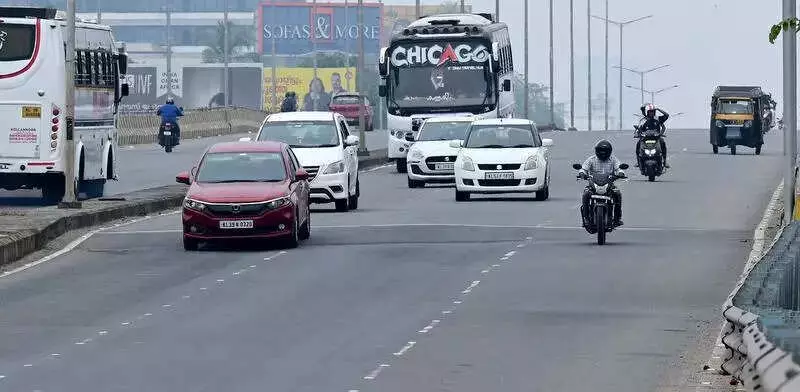
The much-touted NH bypass in Kochi, envisioned as a permanent solution to the city's chronic traffic congestion, is ironically becoming a dangerous hotspot for accidents. A recent severe incident has starkly highlighted the persistent engineering failures plaguing this critical infrastructure, putting daily commuters at serious risk.
A Violent Jolt Exposes Persistent Flaws
The dangers of the bypass moved from a theoretical concern to a painful reality for passenger Job K J. While travelling on a KSRTC bus, he was violently thrown from his seat when the vehicle hit an uneven slope at the section where the approach road merges with the Kumbalam bridge. The impact caused him to suffer serious head injuries after hitting an iron rod on the luggage berth. His wife, Jeejamol, recounted that the bus was moving swiftly on the relatively clear road when the sudden, severe jolt occurred, ejecting Job from the last row.
This is not an isolated event. Officials from VPS Lakeshore hospital confirmed they have treated at least three other cases where individuals were injured in a strikingly similar manner on the same stretch of road. The problem stems from abrupt transitions and uneven slopes at several key junctions along the bypass.

The Root Cause: Soil Settlement on Reclaimed Land
According to senior officials from the National Highways Authority of India (NHAI), the primary culprit is 'soil settlement' or consolidation. This is a geotechnical phenomenon where the ground beneath structures gradually sinks or compresses after construction. In Kochi, the issue is exacerbated because many of these flyovers and approach roads are built over varied soil conditions, largely on reclaimed land.
Professor Samson Mathew from the Civil Engineering Department at NIT Trichy, and former director of the National Transportation Planning & Research Centre, explained the science. "Soil settlement due to consolidation is a significant issue in geotechnical engineering, especially in coastal regions in Ernakulam," he said. The long-term sinking of the approach road creates a height difference where it meets the more stable bridge structure, forming a dangerous bump.
The issue is widespread. It is not confined to the Kumbalam bridge but also affects flyovers at Kundanoor, Vyttila, and Palarivattom, all constructed and managed by the Public Works Department (PWD). An uneven slope due to settlement is also reported at the entry point of the Kumbalam-Aroor bridge.
Search for a Solution and Commuter Suffering
In response to the growing concern, an expert committee visited and examined the problematic spots on December 4, 2025. An NHAI official expressed hope that the committee's findings would lead to a possible solution. Professor Mathew noted that while similar challenges were faced in the Alappuzha-Changanassery section, standard engineering solutions exist, particularly regarding how to compact and fill the approach road near the intersection.
However, for now, it is the ordinary commuter who bears the brunt. Sahadevan Nambiar, former head of Kochi-Aroor Tollways, which maintained the NH-66 section for nine years, acknowledged the recurring problem. "We used to regularly fill the uneven slope and do tarring at regular intervals to fix the issue. A permanent solution would need blocking traffic for a long period, which we can't afford," he stated, highlighting the logistical dilemma.
The threat is particularly acute for two-wheeler riders. Manoj Madhavan, a regular commuter from Panangad, pointed out the risk at the Kundannoor flyover. "Two-wheelers are the most affected, as the riders could lose balance as the slope is barely noticeable, especially at nights," he said. Until a comprehensive and permanent fix is implemented, this vital artery meant for smoother travel will continue to be a treacherous path for Kochi's citizens.