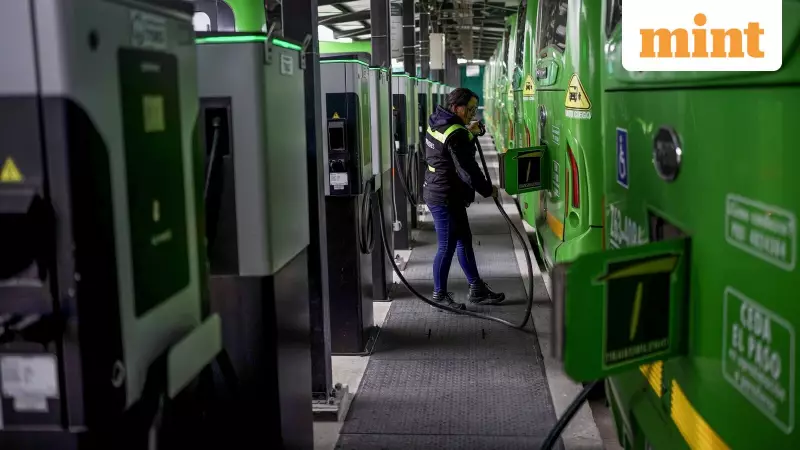
The ambitious plan to deploy 2,800 electric buses in Delhi under the central government's PM E-Drive scheme faces significant hurdles as the city government has failed to meet a crucial financial condition required for the initiative. The delay threatens to derail what is being called India's largest electric bus tender involving 10,900 buses across multiple cities.
The Core Issue: Payment Security Mechanism
At the heart of the problem lies Delhi's inability to establish a Direct Debit Mandate (DDM) with the Reserve Bank of India. This mechanism is essential for the Payment Security Mechanism (PSM) under the PM E-Drive scheme, which ensures automatic deduction of funds from state accounts to guarantee timely payments to bus manufacturers and operators.
The DDM serves as a critical safeguard that builds confidence among private bus suppliers by assuring them that payments will be made on schedule, even if state transport agencies default. Without this financial assurance, Delhi risks losing its allocation of 2,800 electric buses from the larger tender of 10,900 buses valued at approximately ₹10,900 crore.

Constitutional Complications and Urgent Negotiations
The situation is complicated by Delhi's unique status as a Union Territory with a legislature. According to Indian law, the Union Home Ministry oversees finances for Union Territories without legislatures, but Delhi wants to use its own consolidated fund established under the 1993 Delhi Act to meet the scheme's requirements.
Multiple government bodies are now engaged in urgent discussions to resolve the impasse. The Ministry of Heavy Industries, the Reserve Bank of India, the Union Home Ministry, and the Delhi government are exploring potential solutions that would mirror the approach taken by Puducherry, another Union Territory with a legislature that successfully submitted its DDM in October 2023.
"Delhi has now begun meetings with the home ministry and the RBI to resolve this issue," revealed one official familiar with the developments, speaking on condition of anonymity.
Nationwide Progress and Delhi's Lagging Position
While Delhi struggles with the payment security requirement, thirteen other states and Union Territories have successfully submitted their DDMs. These include Gujarat, Karnataka, Rajasthan, Punjab, Telangana, Andhra Pradesh, Madhya Pradesh, Meghalaya, Maharashtra, Uttarakhand, Odisha, Jammu & Kashmir, and Puducherry, according to a November 10 statement from the Ministry of Heavy Industries.
The timing is particularly crucial as states are expected to begin signing contracts with bus manufacturers as early as January 2026. The bidding process for the 10,900 e-buses across five cities—Delhi, Ahmedabad, Surat, Hyderabad, and Bengaluru—has already attracted participation from major players including Tata Motors, JBM Auto, PMI Electro, Pinnacle Mobility, Volvo Eicher, Greencell Mobility, and Evey Trans.
Broader Implications for Electric Mobility
Experts emphasize that the payment security mechanism is fundamental to India's electric bus rollout strategy. Amit Bhatt, India Director of the International Council on Clean Transportation, explained, "The PSM is integral for paying bus makers and operators on time, as these are private sector companies. Scaling public transport is vital for sustainable urbanization, and ensuring timely payments is key to maintaining industry confidence and service quality."
Electric buses represent a significant environmental opportunity as they operate throughout the day, unlike other electric vehicles that have limited usage hours. This results in substantially higher carbon emission reductions compared to two-wheelers or three-wheelers.
The PM E-Drive scheme, which aims to deploy 14,028 electric buses across nine major Indian cities, is scheduled to run until FY28. Combined with the PM E-bus Sewa Payment Security Mechanism that will operate until FY29, these initiatives aim to put more than 40,000 electric buses on Indian roads over the next several years.

According to a CareEdge Ratings report from March 2025, India's annual electric bus sales could surge to approximately 17,000 units by FY27, driven by government subsidies, incentives, and the payment security mechanism. Currently, the country sells about 3,500 electric bus units annually.