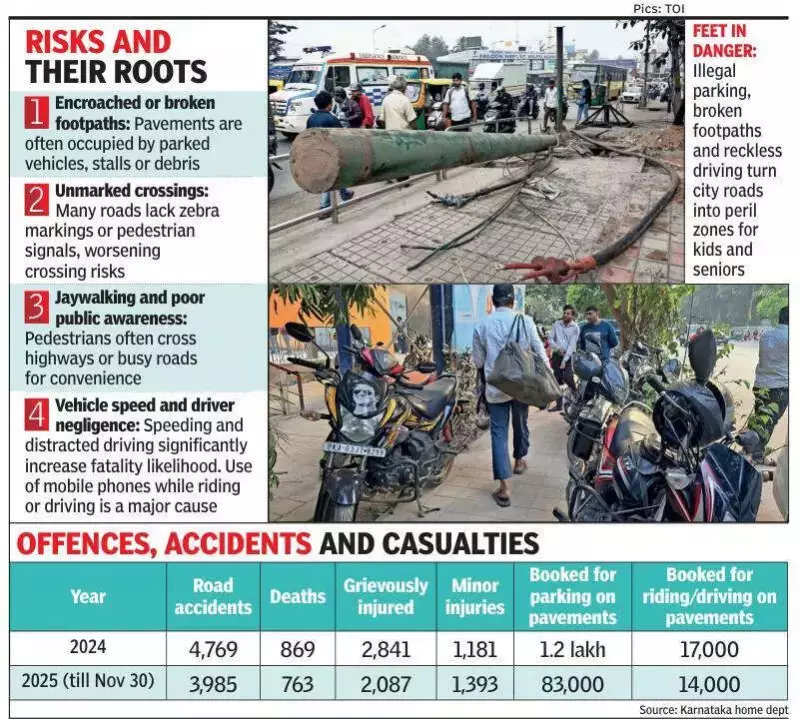
For a metropolis celebrated as India's premier technology hub, Bengaluru presents a shockingly perilous environment for those navigating its streets on foot. Recent police statistics paint a grim picture, revealing that pedestrians account for a staggering proportion of the city's road accident deaths, with the troubling trend showing little sign of abatement.
A Persistent and Deadly Pattern
Data from the city's traffic police indicates a chronic crisis. In the current year, up to November 30, a total of 763 individuals lost their lives in road accidents across Bengaluru. Among these victims, 218 were pedestrians, constituting approximately 28.5% of all fatalities. This pattern is consistent with previous years. In 2024, pedestrian deaths stood at 246 out of 869 total road fatalities. The numbers for 2023 and 2022 were 288 and 248 pedestrian deaths, respectively.
A senior police official expressed grave concern, stating, "At this pace, the city risks ending 2025 with roughly the same or even higher numbers than last year." This forecast underscores the urgent need for effective intervention.

Root Causes: Infrastructure Failures and Reckless Behavior
The tragedy of these statistics is compounded by the fact that most deaths stem from preventable causes. Key factors identified by authorities include rampant rash driving, illegal parking that completely blocks pavements, and severely deficient pedestrian infrastructure.
Officials note that pedestrians, particularly senior citizens, are at extreme risk when forced to cross chaotic roads, navigate unmarked intersections, or walk directly on carriageways because footpaths are either encroached upon, dug up for utility work, or simply broken and unusable. "Pedestrian safety continues to be one of our biggest concerns," affirmed a traffic police officer. "Many of these accidents occur because people are forced to step onto busy roads due to broken or dug-up pavements."
Enforcement data highlights the scale of the problem. In 2024 alone, police booked about 1.2 lakh cases against motorists for pavement parking and an additional 17,000 for riding vehicles on footpaths. By October of this year, 83,000 parking violations and 14,719 riding-on-pavement offences had already been recorded.
Official Responses and Infrastructure Plans
In response to the escalating crisis, the Bengaluru city police have formally written to the Greater Bengaluru Authority (GBA). Home Minister Dr. G Parameshwara confirmed that the communication urges priority action on pedestrian safety infrastructure. Proposed measures include constructing skywalks at 101 identified locations, clearly marking zebra crossings at junctions, and improving street illumination.
Following a recent review meeting, GBA Chief Commissioner Maheshwar Rao instructed civic officials in the city's five corporations to each identify 50 pedestrian-heavy locations in poor condition within their zones and expedite repair works. Other governmental steps include installing grills along road medians to deter jaywalking, repainting lane markings on major routes, and setting up pelican traffic signals at 39 spots.
The issue also gained political attention during the recent legislature session, where Rajajinagar MLA S. Suresh Kumar questioned the government on its actions. The persistent high death toll raises a critical question: why does Bengaluru witness so many fatal accidents, especially involving pedestrians, when its notorious traffic congestion often reduces vehicles to a crawl and the road network has remained stagnant at approximately 13,000 km?
Investigating officers point to a combination of factors: vehicles losing control on narrow roads, speeding on certain stretches, and the absence of safe crossing points like zebra markings or signals. While jaywalking remains a challenge, the core issue is an infrastructure and enforcement system struggling to protect its most vulnerable road users. The coming year will be a crucial test of whether planned interventions can finally reverse Bengaluru's deadly trend for pedestrians.