As the Indian National Congress (INC) marked its 140th Foundation Day on December 28, party president Mallikarjun Kharge hailed its "glorious history" of truth, non-violence, and patriotism. The journey of this political institution, which began in 1885, is a complex saga of India's transition from colonial rule to an independent democracy, witnessing phases of immense influence and significant decline.
The Humble Beginnings: A "Safety Valve" for Grievances
The INC was founded not by an Indian nationalist, but by a retired English civil servant, Allan Octavian Hume. On December 28, 1885, 72 social reformers, journalists, and lawyers gathered at Gokuldas Tejpal Sanskrit College in Bombay (now Mumbai) for its first session. The initial goal was not outright independence but greater self-governance, aiming to influence British policies in favour of Indians. Founding member William Wedderburn described its objectives as the fusion of India's diverse population, national regeneration, and the consolidation of ties between England and India.
For years, the party's methods were largely confined to prayers and petitions, drawing criticism from both the British, who saw it as disruptive, and from Indians, who felt it was too moderate. Its membership was primarily drawn from the educated, upper-class elite, many of whom were Western-educated.

Transformation into a Mass Movement
The party's character began to change dramatically in the early 20th century. Internal differences over strategy led to a split in 1906 between the Moderates, led by Gopal Krishna Gokhale, and the Extremists, led by Bal Gangadhar Tilak. The party reunited in 1915, coinciding with the arrival of Mahatma Gandhi on the national scene.
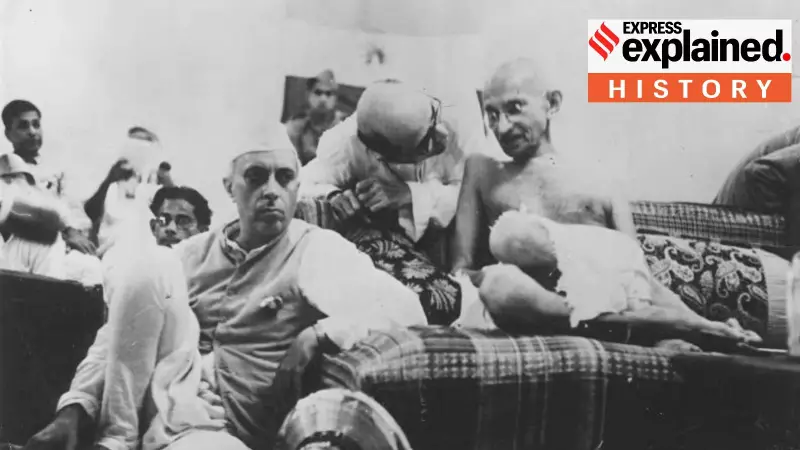
Gandhi's leadership transformed the Congress from a party of elite petitioning to the vanguard of the largest mass movement in history. It adopted methods of non-violent civil disobedience and broadened its social base. At the historic 1929 Lahore session, under the presidency of Jawaharlal Nehru, the Congress declared Purna Swaraj (complete independence) as its goal, a mission fulfilled in 1947, albeit alongside the trauma of Partition.
Gandhi's Evolving Vision and the Post-Independence Trajectory
Mahatma Gandhi's view of the Congress evolved significantly over time. Initially, he saw it as an organisation that "brought together Indians from different parts of India, and enthused us with the idea of nationality." However, after Independence, he envisioned a radically different future for it.
Shortly before his assassination in 1948, Gandhi suggested the Congress should disband as a political party and reorganise itself into a Lok Sevak Sangh (People's Service Society), focusing on grassroots social work and village self-sufficiency, staying out of partisan politics.
This vision was not realised. Instead, the Congress, under Nehru's leadership, chose the path of electoral politics. Capitalising on its legacy from the freedom struggle, it became a hegemonic force, winning the first six general elections consecutively. It championed secularism, socialist-inspired economic planning, and non-alignment in foreign policy.
Internal Splits and the End of Dominance
The party's dominance was punctuated by internal power struggles. After Nehru's death, a split emerged in 1969, leading to the formation of Congress (R) under Indira Gandhi and Congress (O). Indira Gandhi's tenure saw highs like the 1971 victory and the lows of the Emergency (1975-77), which led to the party's first national electoral defeat in 1977.
It returned to power in 1980 but faced a major setback in 1989, failing to secure a majority and marking the end of its single-party dominance. The rise of the Bharatiya Janata Party (BJP) in the 1990s presented a formidable national alternative. While the Congress-led UPA governed from 2004 to 2014, it has since struggled, hitting historic lows in seat numbers. The 2024 elections saw it win 99 seats, a slight recovery but followed by disappointing performances in subsequent state polls, raising persistent questions about its future revival.

The Congress's 140-year journey mirrors the political evolution of modern India itself—from a colonial subject to a vibrant, and often contentious, democracy.