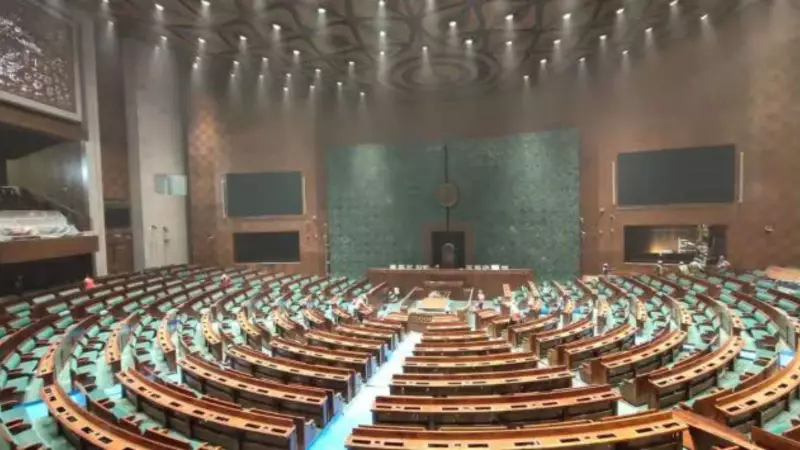
The Winter Session of Parliament commenced on Monday under a cloud of political tension, with a united Opposition front firmly demanding a discussion on the Special Intensive Revision (SIR) of electoral rolls and issuing warnings of potential disruptions if the government remains non-committal.
Opposition's Unified Stand and Government's Response
At a crucial all-party meeting held on Sunday, representatives from various Opposition parties presented a consolidated front. They insisted on debates concerning the SIR, a recent blast in Delhi viewed through the lens of national security, air pollution, and federal issues, including the conduct of Governors. The government, represented by senior ministers including Defence Minister Rajnath Singh and Parliamentary Affairs Minister Kiren Rijiju, listened to the demands but refrained from making any firm commitments regarding the SIR discussion.
Sources indicate that the government's reluctance stems from its position that the SIR is an administrative exercise conducted by the autonomous Election Commission, making it difficult for the government to answer on its behalf. However, in a potential opening for dialogue, Minister Rijiju had previously suggested that a discussion could be possible if the subject was broadened to encompass wider electoral reforms.

Negotiations in Business Advisory Committees
The political maneuvering continued within the Business Advisory Committees (BAC) of both the Rajya Sabha and the Lok Sabha. In the Rajya Sabha BAC, chaired by Vice President C P Radhakrishnan, the government proposed a discussion on '150 years of Vande Mataram,' to which the Opposition agreed. However, they simultaneously pressed for an immediate, short discussion on the SIR, suggesting it could be part of a larger debate on electoral reforms.
A similar scenario unfolded in the Lok Sabha BAC, where the Treasury benches indicated that the first order of business would be the Manipur Goods and Services Tax (Second Amendment) Bill, 2025, citing constitutional obligations. The government's response to the Opposition's demand for a fixed time to debate electoral reforms was that it would 'get back to them.'
Warnings and Broader Political Implications
The Opposition's resolve was underscored by stern warnings. Samajwadi Party leader Ram Gopal Yadav explicitly stated that his party would not allow the House to function if the SIR issue was not discussed. This session is particularly significant for the Opposition, coming after the Bihar poll defeat, offering a platform to unite against the government on a common agenda.
The issue of SIR holds high stakes for several opposition-ruled states like West Bengal, Tamil Nadu, and Kerala, which are scheduled to go to polls next year. The Naveen Patnaik-led BJD, though not part of the INDIA bloc, has also echoed the demand for a discussion on electoral transparency.
Beyond SIR, Opposition leaders like the Congress's Gaurav Gogoi and TMC's Kalyan Banerjee raised concerns about the erosion of parliamentary functioning, alleging disproportionate speaking time for the Treasury benches and fewer bills being sent to Standing Committees for scrutiny.
The government has listed 13 Bills for consideration and passage during the session, which is scheduled to have 15 sittings and conclude on December 19. As the session progresses, all eyes will be on the Monday morning meeting of Opposition floor leaders, convened by LoP Mallikarjun Kharge, to fine-tune their strategy and maintain their united front.