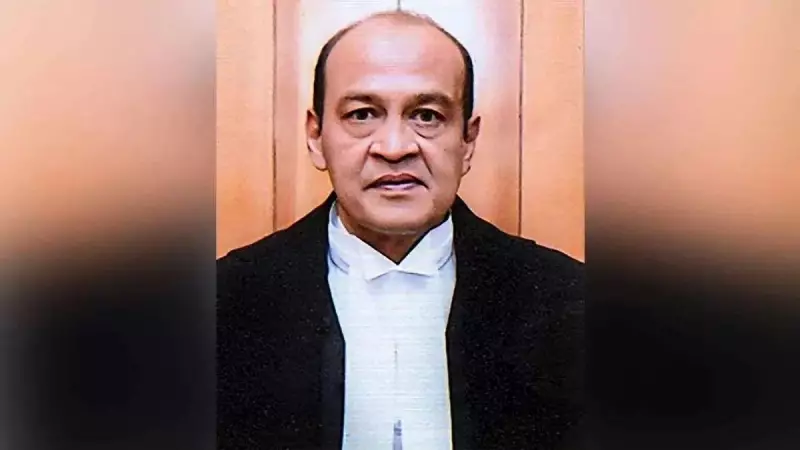
In a landmark ruling that reinforces the autonomy of India's legislative bodies, the Supreme Court has unequivocally affirmed the authority of the Lok Sabha Speaker to constitute an inquiry committee. This decision, delivered on January 7, 2026, centers on the high-profile case involving Justice Varma and sets a significant precedent regarding the separation of powers between the judiciary and the legislature.
The Core of the Controversy
The legal battle stemmed from a challenge against the Lok Sabha Speaker's decision to form a special inquiry committee to investigate allegations concerning Justice Varma. Petitioners had contested this move, arguing that it overstepped constitutional boundaries and potentially infringed upon judicial independence. They sought the Supreme Court's intervention to curtail what they perceived as an expansion of parliamentary power into the domain of the judiciary.
The Supreme Court bench, after meticulous deliberation, rejected these arguments. The justices underscored that the power to regulate its own internal proceedings, including the mechanism to conduct inquiries into matters concerning its members or issues brought before it, is a fundamental privilege of the House. The formation of an inquiry committee by the Speaker falls squarely within this privileged domain and is essential for the Lok Sabha to function effectively.

Supreme Court's Reasoning and Key Observations
The Court's judgment provided a robust constitutional interpretation. It highlighted that the Speaker, as the presiding officer of the Lok Sabha, acts as its guardian of rights and privileges. The authority to appoint a committee to look into specific matters is a derivative of this overarching responsibility. The bench observed that such committees are fact-finding bodies for the House and do not, in themselves, pronounce judicial verdicts.
This ruling draws a clear line, affirming that the legislature's right to inquire into matters of public importance is not subject to judicial review, provided established procedures are followed. The Court emphasized that respecting this separation is crucial for the healthy functioning of a democracy, where each pillar—legislature, executive, and judiciary—operates within its designated sphere without undue interference from another.
Broader Implications for Parliamentary Sovereignty
The verdict has immediate and long-term consequences for India's parliamentary democracy. Primarily, it fortifies the position of the Lok Sabha Speaker, confirming that decisions pertaining to the internal investigative mechanisms of the House are largely insulated from external legal challenges. This empowers the legislature to hold its own inquiries without the looming threat of judicial stay orders, based on procedural grounds.
Furthermore, the judgment reinforces the concept of parliamentary sovereignty in its internal affairs. It signals to future Speakers and Members of Parliament that the House possesses the inherent tools to maintain its integrity and address allegations. For the ongoing Justice Varma case, it means the inquiry committee constituted by the Speaker can proceed with its work, and its findings will be tabled before the Lok Sabha for further action as per the rules.
Legal experts view this as a stabilizing ruling that prevents the judiciary from being drawn into every procedural decision of Parliament. However, some constitutional scholars caution that the principle must be balanced with fundamental rights, ensuring that such parliamentary powers are not exercised arbitrarily. The Supreme Court, in its wisdom, has left the door open for judicial review in cases of egregious violation of constitutional mandates or natural justice, but has set a very high bar for such interventions.
In conclusion, the Supreme Court's affirmation on January 7, 2026, is a decisive moment for India's democratic institutions. By upholding the Lok Sabha Speaker's authority to form the inquiry committee in the Justice Varma matter, the Court has championed the doctrine of separation of powers and strengthened the self-regulatory capacity of the nation's premier legislative body.