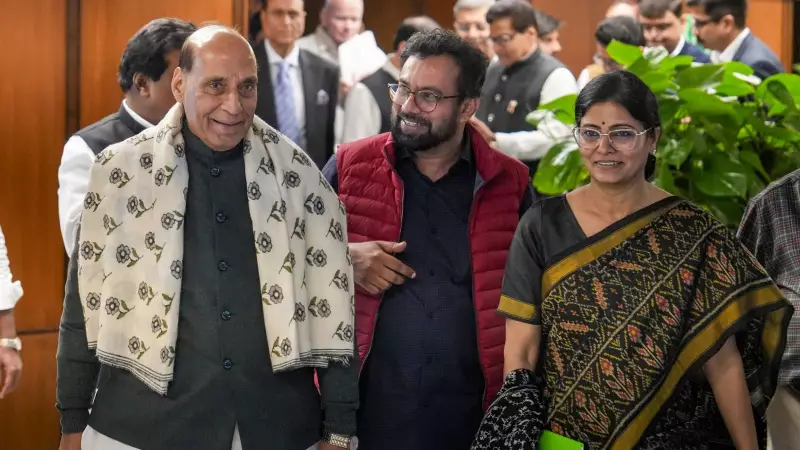
As the Winter Session of Parliament commences on Monday, December 1, 2025, concerns are mounting about the institutional health of India's parliamentary democracy. The session begins under the shadow of a potential stalemate between the government and Opposition over discussions on Special Intensive Revision (SIR) of electoral rolls, continuing a worrying trend of legislative gridlocks that have become routine in recent years.
Breakdown in Dialogue Threatens Parliamentary Function
Former Lok Sabha Secretary-General P D T Achary has issued a stark warning about the erosion of parliamentary institutions, attributing the decline to a fundamental breakdown in communication between the government and opposition. "The erosion stems from a breakdown in dialogue. There must be regular meetings between the Leader of the House, Prime Minister Narendra Modi, and the Leader of the Opposition, Rahul Gandhi," Achary emphasized during his assessment of the current parliamentary crisis.
Achary described the diminishing deliberation as undermining Parliament's very purpose, noting that this disturbing trend predates the last decade. "The Opposition raises issues and wants them discussed. But the government does not give importance to that and looks only at its business," he observed, characterizing the current passage of Bills as a "mockery of legislative business."

Alarming Statistics Reveal Deepening Crisis
The recently concluded Monsoon Session between July 21 and August 21, 2025, provides concrete evidence of the institutional decline. According to data from PRS Legislative Research, the Lok Sabha functioned just 29% of its scheduled time while the Rajya Sabha managed only 34%. The core accountability mechanisms suffered severely, with Question Hour completing merely 23% of scheduled time in the Lower House and a dismal 6% in the Upper House.
Despite eight Bills being passed during the session, scrutiny was minimal at best. The Regulation of Online Gaming Bill was approved by both Houses in a single day after just six minutes of discussion in the Lok Sabha and 23 minutes in the Rajya Sabha. Similarly, the long-pending Merchant Shipping Bill, 2024, received only 20 minutes of debate in the Lok Sabha and 10 minutes in the Rajya Sabha.
Historical Trends Show Structural Decline
The current parliamentary difficulties are part of a broader structural decline rather than an isolated phenomenon. The 17th Lok Sabha (2019-2024) recorded the fewest sittings of any full-term Lok Sabha since 1952, meeting for only 55 days per year on average compared to 135 days during the first Lok Sabha. Notably, 11 of its 15 sessions were adjourned early, and it became the first Lok Sabha without a Deputy Speaker.
Scrutiny mechanisms have weakened significantly over time. While 60% or more Bills were referred to committees during the 14th and 15th Lok Sabhas, this figure dropped to 20% or below in the 16th and 17th Lok Sabhas. Time spent on budget discussions has also steadily declined since the 1990s.
Congress MP Manish Tewari expressed grave concern about these developments, stating that "Parliament cannot be a forum to rubber-stamp legislation of the government... The legislature has completely knee-capped itself." He highlighted that Standing Committees were becoming "redundant" and questioned the neutrality of presiding officers.
Government and Opposition Trade Blame
The political blame game continues unabated, with both sides attributing responsibility for the parliamentary impasse to each other. Congress Rajya Sabha MP Syed Naseer Husain asserted that functional responsibility ultimately lies with the government. "The government's agenda comes as Bills that need to be discussed. The Opposition is willing... When they are not accommodated, the Opposition also has the right to protest," he stated.
However, the government maintains that Opposition disruptions are primarily responsible for the gridlock. Union Parliamentary Affairs Minister Kiren Rijiju argued, "If the entire agenda of the Opposition is driven by one or two failed leaders, it is very difficult... After all, who are the biggest victims? It is the Opposition MPs." BJP spokesperson Anil Baluni echoed this position, claiming that the people are watching the Opposition's behavior and rejecting them politically.

Despite the current tensions, the Budget Session of 2025 showed that productive parliamentary functioning remains possible, with unusually high productivity rates of 111% in the Lok Sabha and 112% in the Rajya Sabha. However, these remain exceptions in a broader downward trajectory, as evidenced by the 2024 Winter Session where productivity plunged to 52% in the Lok Sabha and 39% in the Rajya Sabha.
Political scientists have documented these signs of institutional erosion extensively. In his 2017 volume "The Indian Parliament and Democratic Transformation," Panjab University professor Ashutosh Kumar noted that the enhanced representative character of Parliament had not led to "institutional well-being," pointing to declining quality of debate and increasing absenteeism that sometimes leaves Parliament without the required constitutional quorum.