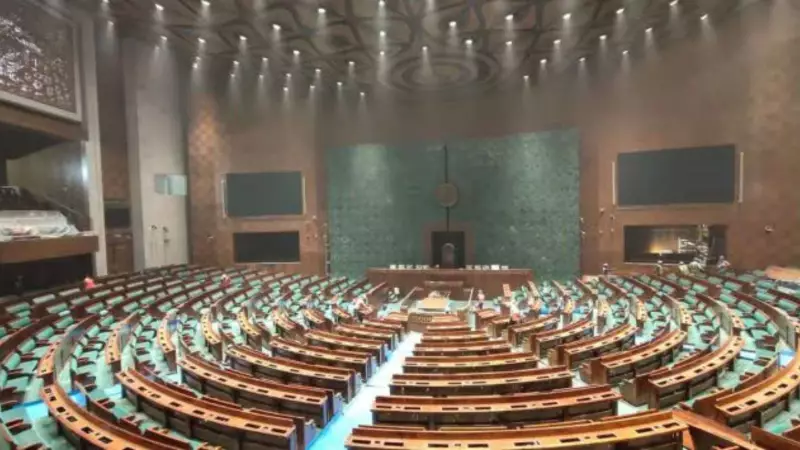
As India's Parliament reconvenes, a critical question demands attention: why is the nation's legislature steadily retreating from its constitutional role? The very foundation of parliamentary democracy faces unprecedented challenges that threaten the balance of power essential for a healthy republic.
The Shrinking Democratic Space
The evidence of parliamentary decline appears starkly in the official records. The first Lok Sabha between 1952 and 1957 met for an average of 135 days each year, demonstrating robust engagement in a nascent democracy. In shocking contrast, the 17th Lok Sabha serving a much larger and more complex nation sat for merely 55 days annually.
This dramatic reduction represents more than administrative efficiency—it signals a legislature growing silent, its constitutional role as the nation's primary oversight body being systematically hollowed out. The decreasing sitting days reflect a broader pattern of democratic retreat that should concern every Indian citizen.

The Anti-Defection Law: From Solution to Problem
Originally designed to prevent unprincipled floor-crossing, the anti-defection law has transformed into an instrument that undermines parliamentary democracy itself. The legislation has effectively eliminated individual conscience, constituency representation, and common sense from parliamentary proceedings.
Today, Members of Parliament function less as representatives of their constituents and more as subjects of their party's ubiquitous whip. Their votes come predetermined by binding diktats, with disobedience carrying the penalty of political annihilation through disqualification.
This inversion strikes at the heart of Parliament's most sacred functions. The power of the purse—the fundamental principle that no tax can be levied nor expenditure incurred without parliamentary approval—becomes meaningless when members must approve financial demands under threat of disqualification.
Consequences for Democratic Accountability
The legislative ennui extends beyond mere numbers. An executive showing profound insensitivity to Opposition concerns has created a vicious cycle of disruption and disengagement. The fundamental democratic principle—that the government may have its way, but the Opposition must have its say—stands inverted.
When almost every notice for discussion and every adjournment motion on matters of public urgency gets summarily dismissed, disruption remains the only tool in the Opposition's arsenal. Vital instruments of daily accountability like Question Hour and Zero Hour become the first casualties of ensuing chaos.
The government often chooses to pass monumental legislation in mere minutes, with minimal discussion and scant regard for legislative scrutiny. Parliamentary committees, meant to be democracy's workshops where legislation gets refined through cross-party deliberation, struggle to maintain relevance.
Constitutional offices intended as neutral arbiters and guardians of parliamentary privilege increasingly exercise prerogative power to discipline Opposition members, compromising their impartiality.
Historical Context and Global Comparisons
To understand how far India has strayed, one must examine the origins of the Westminster model itself. The Oxford Parliament of 1258 established that the king must govern with elected council advice, that ministers would serve fixed terms, and that Parliament would meet at regular intervals—liberating governance from monarchical whims.
This system specifically designed to subordinate the executive to the legislature has evolved differently in India compared to other Commonwealth realms. The United Kingdom's Prime Minister's Questions ensure weekly, direct public accountability. Robust committee systems in the US Congress and UK Parliament compel executive officials to testify, with their evidence shaping law and policy.
In India, Parliament has regressed from a robust legislature possessing unfettered oversight powers into a mere approval body. The transformation would dismay the nation's founding fathers, who carefully adopted the Westminster model for India's democratic framework.

The Path to Restoration
This decline remains reversible, but recovery demands collective political will to reclaim the Constitution's spirit. Essential corrective measures include radical reconsideration of the anti-defection law to restore legislator independence, reaffirmation of the government's primary responsibility in ensuring House functionality, and refurbishment of constitutional offices' neutrality.
Without these interventions, India's parliamentary democracy, while structurally intact, will continue echoing with silence that speaks volumes about diminishing accountability of the powerful to the people they serve. The time for course correction is now, before the retreat becomes irreversible.