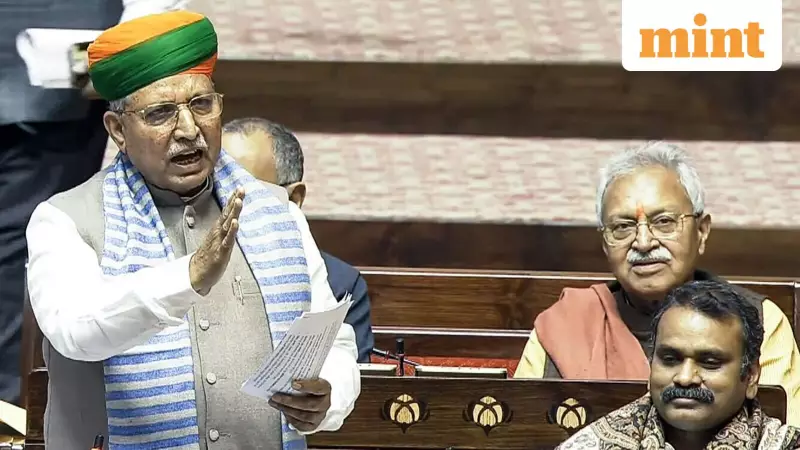
In a sharp poetic retort, Union Minister of State for Law and Justice Arjun Ram Meghwal invoked the legendary Urdu-Persian poet Mirza Ghalib to critique the Indian National Congress's repeated electoral setbacks. The remarks were made during a heated debate on electoral reforms in the Rajya Sabha on Monday, December 15, 2025, as part of the ongoing Winter Session of Parliament.
Ghalib's Verse Becomes Political Arsenal
Addressing the Upper House, Meghwal narrated an anecdote about the 19th-century poet to illustrate his point about misguided effort. "A person went to Ghalib and said he works hard but is not successful. Ghalib told him — ‘Umar bhar is bhool mein jeete rahe Ghalib, dhool chehre pe thi aur hum aayina pochthe rahe’," quoted the Minister. Translating the couplet's essence, he implied that the Congress party is toiling diligently, but in the wrong direction, akin to wiping a mirror when the dust is on one's own face.
This was not the first time Meghwal used this literary device; he had employed the same couplet the previous week in the Lok Sabha to counter the opposition's allegations of 'vote chori' or vote theft. The exchange is part of a broader confrontation between the ruling National Democratic Alliance (NDA) and the opposition INDIA bloc over the integrity of the electoral process.

Defending Voter List Revision and Constitutional Integrity
Shifting from poetry to policy, Meghwal mounted a strong defence of the Election Commission of India and the government's initiative of Special Intensive Revision (SIR) of voter lists. He accused opposition parties of doubting constitutional bodies like the ECI and Electronic Voting Machines (EVMs) merely to deflect blame from their own political failures.
The Minister emphatically stated that the SIR exercise is crucial to cleanse the electoral rolls of ineligible or fake voters, thereby upholding the foundational democratic principle of ‘One person, one vote, one value’. He anchored this argument in the legacy of Dr. B.R. Ambedkar, the chief architect of the Indian Constitution, reminding the house that the concept of universal adult franchise is built upon this very pillar.
"Our constitution and electoral process is based on this principle. So, when under SIR, the same is being undertaken to take out people who are not eligible from voter lists, why are they [Opposition parties] opposing it?" Meghwal questioned, noting that such revisions have been conducted under various governments in the past.
A Clash of Narratives on Electoral Trust
The debate underscored a deep political divide. Meghwal attributed the BJP's electoral successes to the correct alignment of neta, niti and niyat (leader, policy, and intention). "If neta, niti and niyat are correct, people do respond. Our leader’s intention is right, your’s may not," he asserted, positioning the Narendra Modi government's mantra of 'Reform, Perform and Transform' as the nation's path to development.
In contrast, the opposition has framed the SIR drive as a suspicious activity that could lead to the disenfranchisement of legitimate voters, accusing the ruling party of attempting 'vote theft'. The Winter Session, which began on December 1, has seen intense sparring on this issue, with both sides trading serious allegations. The session is scheduled to continue until December 19.
Through his blend of cultural reference and constitutional argument, Meghwal's intervention aimed to solidify the government's narrative: that its actions are rooted in democratic purity, while the opposition's resistance stems from an inability to accept its diminished public mandate.