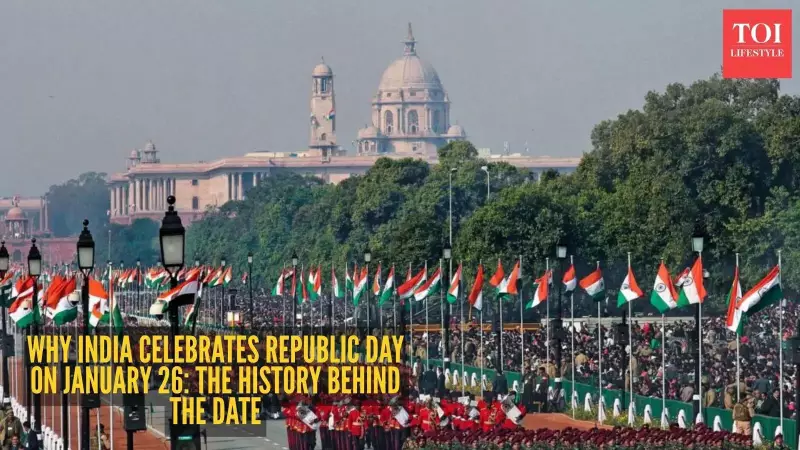
Every winter, as dense fog envelops New Delhi and preparations for the grand Republic Day parade intensify, a recurring historical question emerges among citizens. While the ceremonial routines, patriotic anthems, and flag-hoisting rituals are familiar, the specific selection of January 26 as Republic Day remains a puzzle for many. India achieved independence on August 15, 1947, yet the nation waited nearly two and a half years to implement its Constitution. Why was this particular date chosen to mark the birth of the Republic? The answer lies not in administrative delays or drafting committee inefficiencies, but in a deeply symbolic and emotional decision rooted in India's freedom struggle.
The Historical Significance of January 26
To comprehend the essence of Republic Day, one must look beyond 1947 and revisit the winter of 1929. History often operates in cyclical patterns, and for an entire generation of freedom fighters, January 26 was originally celebrated as Independence Day. As the 1920s concluded, the Indian independence movement faced a critical juncture. Britain proposed "Dominion Status," which offered limited autonomy while retaining the British Crown's ultimate authority. This compromise was viewed by some Congress veterans as a strategic step forward, but younger leaders like Jawaharlal Nehru and Subhas Chandra Bose rejected it as a subtle form of subjugation.
The Purna Swaraj Resolution and Its Impact
In December 1929, during the Lahore session of the Indian National Congress, a pivotal shift occurred. The assembly passed the "Purna Swaraj" resolution, unequivocally rejecting Dominion Status and demanding complete independence from British rule. To solidify this resolve, Congress declared that the last Sunday of January 1930 would be commemorated as "Independence Day." That Sunday fell on January 26, when thousands of Indians publicly pledged to fight for absolute liberty, marking a psychological rupture from the British Empire. For the subsequent 17 years, January 26 served as an annual symbol of defiance and national aspiration.

The 1947 Conundrum and Mountbatten's Role
The transition of India's independence date to August 15, 1947, was influenced by Lord Mountbatten, the last Viceroy of India. He selected this date because it coincided with the second anniversary of Japan's surrender in World War II, a moment of personal significance to him. While the nation rejoiced at gaining freedom in August, there was an underlying sentiment of loss regarding January 26, which had been the emotional cornerstone of the independence movement for nearly two decades.
Operating Under Borrowed Legal Frameworks
An often-overlooked nuance is that on August 15, 1947, India became independent but not yet a republic. The country functioned as a "Dominion," with King George VI as the nominal head of state, and laws were still based on the colonial Government of India Act of 1935. The Constituent Assembly, led by Dr. B.R. Ambedkar, dedicated nearly three years to drafting a permanent Constitution, which was formally adopted on November 26, 1949.
The Symbolic Delay and Republic Day's Inception
Legally, the Constitution could have been enforced immediately in November 1949. However, India's leaders intentionally paused its implementation. They recognized that January 26, 1950, would mark the 20th anniversary of the Purna Swaraj pledge, offering a poetic opportunity to revitalize the "lost" date. This deliberate delay was driven by sentiment and symbolism, transforming January 26 from a day of pledging freedom in 1930 to a day of fulfilling that promise in 1950. On that date, the colonial Government of India Act was repealed, the Constitution became supreme, and India officially transitioned into a Sovereign, Democratic Republic with its own President.

Distinguishing Independence Day and Republic Day
While these two national holidays are sometimes conflated, their meanings are distinctly separate. August 15 commemorates the end of foreign rule and the breaking of colonial chains. In contrast, January 26 celebrates the establishment of self-governance and the forging of a national identity through India's own Constitution. The choice of January 26 serves as an annual reminder that India's democracy was not merely granted in 1947 but was a vision cultivated decades earlier during the freedom struggle. The grand parade witnessed today is a tribute to those who courageously declared their freedom long before it was officially recognized.