As Chief of Army Staff General Upendra Dwivedi prepares for his annual press conference ahead of Army Day, a historical episode from 1949 offers a crucial lesson in civil-military relations. The event involves India's first Indian Army chief, General K M Cariappa, and Prime Minister Jawaharlal Nehru, who firmly established the principle of an apolitical military force.
The Public Praise That Prompted a Prime Ministerial Rebuke
On January 15, 1949, General K M Cariappa made history by becoming the first Indian to take over as the commander-in-chief and chief of army staff of the Indian Army. Merely months into his tenure, an incident occurred that would define the relationship between the government and the military for decades to come.
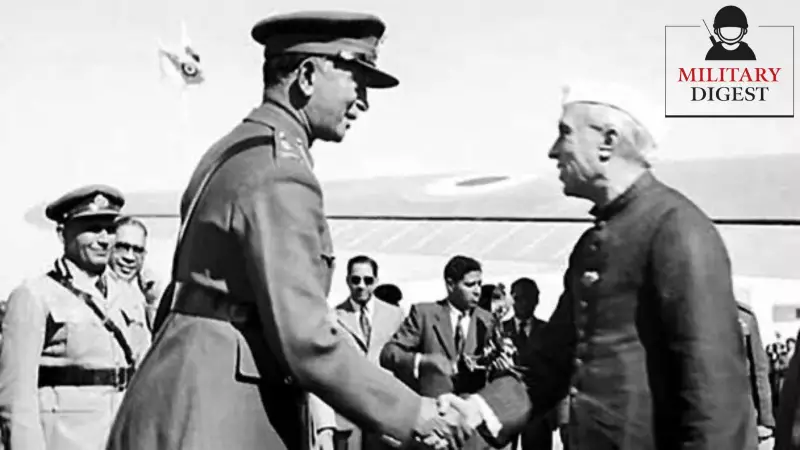
During an interview in Dehradun on May 2, 1949, General Cariappa publicly praised the government led by Prime Minister Jawaharlal Nehru. He stated that "the achievement made by the country under Pandit Nehru’s leadership in so short a period has no parallel in history." He further highlighted Nehru's success at the recent Commonwealth Conference in London, calling it a "great triumph."
Nehru, however, was not pleased. On May 24, 1949, he wrote a formal letter to the Army Chief, now part of the Nehru Archives, expressing his strong disapproval. While acknowledging his gratitude for the kind words, Nehru raised a fundamental question about the role of military officers in public discourse.
Nehru's Firm Doctrine: The Army Must Stay Out of Politics
In his letter, Nehru articulated a clear and enduring principle. He questioned whether senior officers, civil or military, should express opinions on political subjects in public. He suggested that officers should limit public speeches to matters strictly concerning their professional work or non-political social and cultural subjects.
"What you said was harmless enough, but there is always a danger in touching upon political questions," Nehru wrote. He argued that if it was improper for an officer to criticise the government, then praise should also be avoided to maintain absolute neutrality. He advised that the safest course was for all officers to "avoid public speaking or public statements completely" except on very limited, non-political topics.
Nehru emphasized that he was drawing Cariappa's attention to this precisely because, as the first Indian Army Chief, Cariappa was setting a precedent for the entire force. The Prime Minister was determined that the Indian Army should not get entangled with politics in any manner. He cited the example of British Field Marshal Bernard Law Montgomery, whose casual public remarks had repeatedly embarrassed governments, as a cautionary tale.
Later Disagreements and the Legacy of an Apolitical Stance
The dialogue, and at times disagreement, between Nehru and Cariappa on the military's role continued even after the latter's retirement. In 1958, Cariappa wrote to Nehru expressing unhappiness over the appointment of J K Bhonsle, a former Indian National Army member, as Lieutenant Governor of Himachal Pradesh. Cariappa viewed Bhonsle's INA service as an act of disloyalty.
Nehru responded with a nuanced perspective on the complex loyalties during the freedom struggle. He refused to condemn those who, under "very peculiar circumstances," chose to serve the nation differently. This exchange further highlighted the ongoing negotiation of history, loyalty, and protocol in a young nation.
Another point of contention was the military honours performed at Rajghat, Mahatma Gandhi's samadhi, on January 30. Cariappa found the ceremonial rifle volley and bugle calls "out of place" in that atmosphere of sanctity. Nehru responded that these honours were decided upon after careful consideration.
The core principle established by Nehru's 1949 letter, however, remained untouched: the Indian Army must remain steadfastly apolitical. This foundational episode, revisited as General Dwivedi engages with the media ahead of Army Day, continues to underscore the critical importance of the military's neutrality in the world's largest democracy. The tradition of the annual press conference itself is now conducted within this long-standing framework, where the Army informs without endorsing, and engages without politicizing.