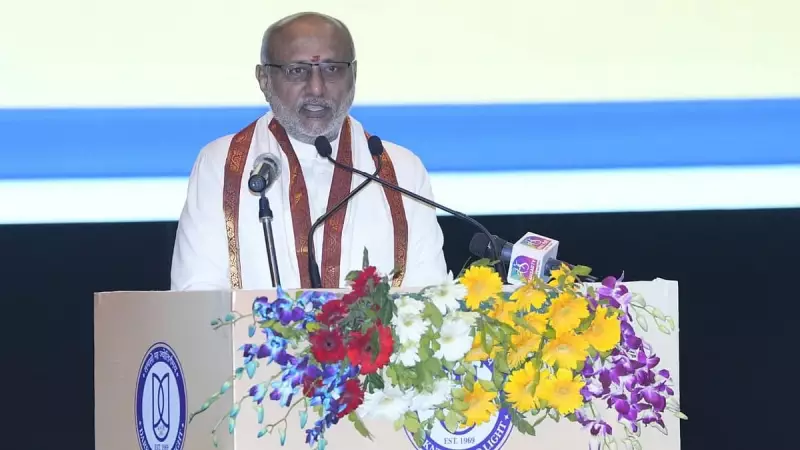
Vice President Jagdeep Dhankhar delivered a powerful address at the 7th convocation of Jawaharlal Nehru University (JNU), championing the core principles of a vibrant democracy. Speaking to a gathering of students, faculty, and dignitaries on Friday, February 23, 2024, the Vice President underscored that debate, dissent, and dialogue are not just permitted but are essential components of a healthy democratic system.
Defining the Pillars of a Vibrant Democracy
In his keynote speech, Vice President Dhankhar articulated a clear vision for democratic engagement. He stated that a thriving democracy is built on the foundation of respectful discourse and the free exchange of ideas. While emphasizing the importance of dissent, he clarified that it must be expressed within the constitutional framework and should never morph into a campaign of "denigration and defamation" of the nation's institutions.
The Vice President pointed out that the Indian Constitution provides a robust mechanism for redressal of grievances. He urged citizens, especially the youth, to utilize these democratic channels rather than resorting to methods that undermine the nation's integrity. His message was a call for constructive criticism that strengthens the democratic fabric instead of tearing it down.

A Call to Uphold Constitutional Values
Jagdeep Dhankhar, who also serves as the Rajya Sabha Chairman, reflected on the sacred duty of preserving India's constitutional ethos. He reminded the audience that the nation's democratic institutions have been carefully built over decades and must be protected. The Vice President's remarks are seen as a significant intervention in the ongoing national conversation about the limits and liberties of free expression in academic and public spaces.
The convocation ceremony was a momentous occasion for the university, where hundreds of students received their degrees. The Vice President's presence and his pointed address added considerable weight to the event, directing the spotlight on JNU, an institution often at the center of political and ideological debates in the country.
Broader Implications for Academic Freedom
The Vice President's speech at JNU resonates beyond the university's campus. It touches upon the delicate balance between academic freedom, national pride, and democratic responsibility. By advocating for debate and dissent while warning against defamation, the address sets a framework for how contentious issues can be discussed in public forums, particularly in premier educational institutions.
This endorsement of spirited discussion from a high constitutional authority is likely to influence the discourse on campus politics and student activism across India. It reinforces the idea that universities are vital spaces for intellectual contestation, but such contestation must be coupled with a deep respect for the nation's constitutional journey and its governing institutions.
In conclusion, Vice President Jagdeep Dhankhar's JNU convocation address serves as a contemporary manifesto for democratic conduct. It champions the right to disagree while firmly anchoring that right to a foundation of constitutional morality and national respect. The message is clear: a healthy democracy thrives on debate, but it survives on mutual respect and institutional integrity.