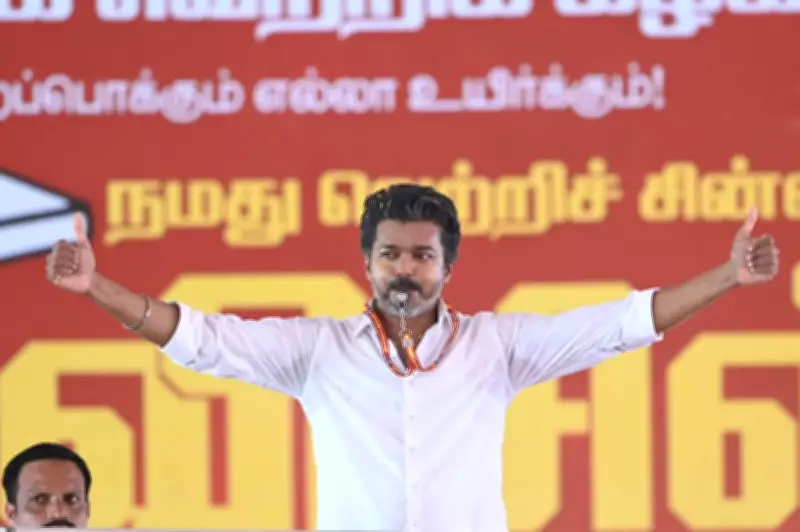
Chennai: When Congress leader and visiting Ashoka University professor Praveen Chakravarty entered his classroom after C Joseph Vijay assumed office as Tamil Nadu's chief minister, he was greeted with songs from the actor's hit films, whistles, and a barrage of questions about the state's new leader. "Good morning, Professor. Can we study Vijay today?" students asked, reflecting an unprecedented academic interest.
"This was a university in Haryana with students from all parts of India, predominantly the north, and yet there was such an interest in Vijay's rise to power," says Chakravarty, who had met Vijay before the 2026 Tamil Nadu assembly elections and is now the TVK government's Rajya Sabha nominee. "I teach political economy, but I spent the first part of the class answering questions about the 'Vijay phenomenon'. I've never seen this level of interest before."
National Academic Buzz
Barely a month after Vijay assumed office, he has become a hot topic of discussion in college classrooms and research circles across the country, spanning disciplines from political science and anthropology to cultural studies. "My own university will likely have a case study on him next year," says Chakravarty, adding that he has received invitations from Shiv Nadar University and Krea University to speak on the topic.

Bengaluru-based political anthropologist Nisar Kannangara, who is studying Vijay's rise, notes a knowledge gap. "Academics failed to predict it. It suggests a knowledge gap," he says. Many scholars believed cinema-driven politics in Tamil Nadu was fading after Kamal Haasan's unsuccessful political foray and Rajinikanth's decision to stay out of active politics. "Few anticipated the scale of support Vijay would mobilise. I know researchers who have moved away from studying cinema and politics. Now they are returning to the subject."
Anthropological Perspectives
At the French Institute of Pondicherry, anthropologist A S Arun Kumar is revisiting his PhD thesis on cinema and politics. "What interests me now is what Vijay reveals about the changing relationship between cinema, stardom and politics. We've studied film-star chief ministers such as M G Ramachandran, N T Rama Rao and, more recently, Chiranjeevi. But something different is happening now. The charismatic appeal of the matinee idol is giving way to a vigilante hero in politics."
Research papers have been popping up online too, examining the phenomenon from various angles.
Technology-Driven Mobilisation
Ramu Manivannan, former head of the department of politics and public administration at the University of Madras, believes Vijay's rise is a case study not in celebrity politics but in technology-driven political mobilisation. "One of the biggest revelations of the 2026 poll is that traditional explanations like cinema stardom alone are not sufficient," says Manivannan, a visiting professor in Southeast Asian colleges. "Vijay's TVK had no clearly articulated ideology, unknown candidates, and mostly only virtual interaction with people. Politically, it should have been a disaster. Yet technology turned it into a wonder, made it viral. It must be studied for how else would you develop an antiviral?"
The academic community is now racing to document and analyse this unique political transition, which blends celebrity appeal with digital-age campaigning.