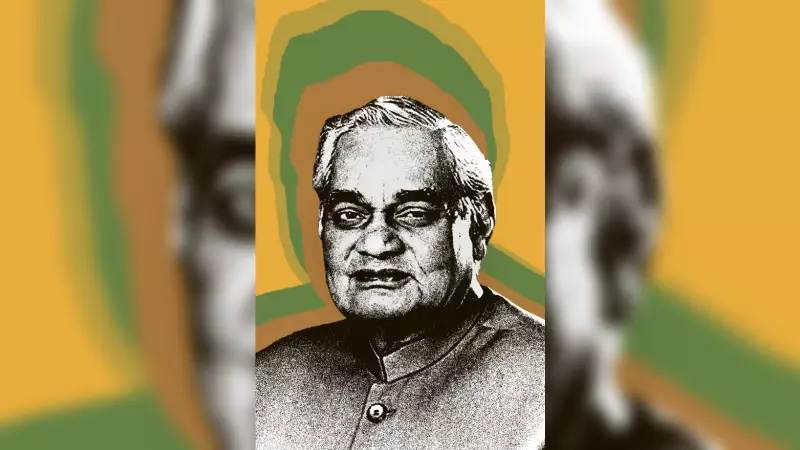
The centenary year of former Prime Minister Atal Bihari Vajpayee, described as an 'ajatshatru' or one without enemies, concluded on December 25, 2025. He is remembered as a gifted orator, poet, and a leader who placed the nation above party, whose political era and aura are predicted to span decades, if not centuries. His unique approach to power and opposition continues to offer critical lessons for India's current political landscape.
The Architect of Coalition Dharma
From an ideological standpoint, Vajpayee is credited as India's first genuine non-Congress prime minister. He fundamentally changed how coalitions were perceived in Indian politics. Earlier seen as unstable political compulsions, Vajpayee reframed them as 'the aspiration of the people'.
He was the first Prime Minister to successfully run a coalition government comprising over 20 parties for a full five-year term, giving birth to the enduring concept of 'coalition dharma'. As Prime Minister Narendra Modi noted in an obituary, Vajpayee was 'ahead of his times'.

His character was tested early. After his 13-day government fell in 1996, his dignified departure speech remains iconic: 'Sarkaren aayengi aur jaayengi, partiyan banengi aur bigadengi, magar ye desh rehna chahiye, desh ka loktantra amar rehna chahiye' (Governments will be formed and dissolved, parties come and go, but this nation should remain and its democracy should be eternal). He lost power again in 1999 by a single vote, yet famously advised, 'Just make sure you don't lose your laughter.' He had the last laugh, leading a stronger coalition to a full term from 1999 to 2004.
Infusing Democratic Spirit in the BJP
While Vajpayee may not have completely transformed the character of power politics, he profoundly influenced his own party, the BJP. He believed the character of power is constant but must be transformed through personal example. This ethos shaped the BJP's role as a constructive opposition during the UPA years.
A glowing testament to this was Sushma Swaraj's final address as Leader of the Opposition in 2014. In a true Vajpayee spirit, she praised ruling side leaders like Prime Minister Manmohan Singh and Sonia Gandhi for enabling Parliament's function. She concluded by emphasising the core Vajpayee message: 'we are adversaries, not enemies'.
Prime Minister Modi has upheld this spirit, running a coalition government despite absolute majorities in 2014 and 2019, and extending the principal opposition status to Congress even when it didn't numerically qualify.
The Opposition's Contemporary Dilemma
The article, penned by Ram Madhav, presents a pointed critique of the current opposition. It recalls that some opposition leaders once told Vajpayee he was the 'right man in the wrong party', to which he retorted, 'What good is this right man for you anyway?' The piece argues that the last few years have shown the opposition's politics has no place for the Vajpayee spirit.
Drawing a stark historical parallel, the article references Joseph Goebbels, who after being elected to the German Reichstag in 1928, noted that democracy gives its enemies the means to its own destruction. The piece poses a critical question to India's opposition: Will it remain 'Goebbelsian', or can it find its own 'right man' and embrace a constructive democratic spirit?
The Union Home Minister's recent statement that an investigation into a terror attack will put Pakistan in the dock internationally underscores the context of national security within which this political introspection occurs. Vajpayee's legacy, therefore, is not just a historical remembrance but a live framework for evaluating political conduct, coalition management, and the very health of Indian democracy today.