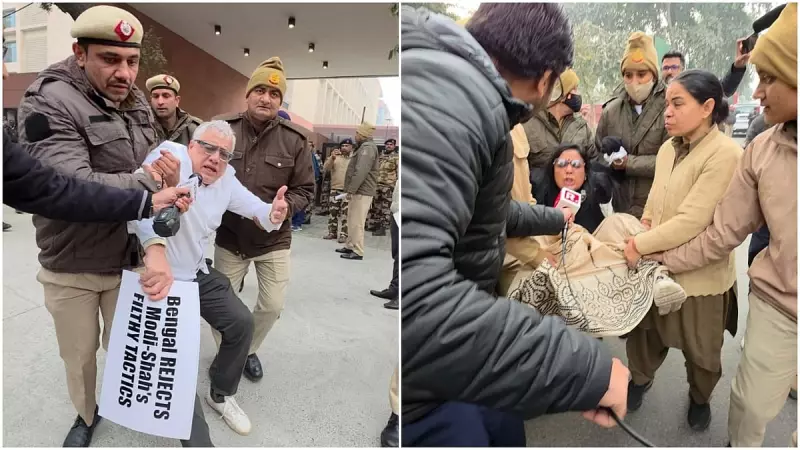
A major political confrontation unfolded in the national capital on Friday as Members of Parliament from the Trinamool Congress (TMC) staged a fiery protest outside the office of Union Home Minister Amit Shah. The demonstration was a direct response to raids conducted by the Enforcement Directorate (ED) on the offices of the political consultancy firm I-PAC in Kolkata.
Leaders Detained Amid Heated Demonstrations
The protest, led by prominent TMC parliamentarians, quickly drew the attention of Delhi Police. MPs Derek O'Brien and Mahua Moitra were among those detained as the demonstration escalated outside the high-security zone housing the Home Minister's office. Videos of the protest and subsequent detentions were widely circulated on social media platforms, including by news agencies PTI and ANI.
The TMC leaders were demanding answers and condemning the central agency's action against Indian Political Action Committee (I-PAC), which has historically worked with the ruling party in West Bengal. The MPs alleged that the raids were a politically motivated move aimed at intimidating the opposition ahead of crucial electoral cycles.
The Trigger: ED Raids in Kolkata
The spark for this Delhi protest was ignited a day earlier, on Thursday, January 8, 2026, when teams from the Enforcement Directorate carried out searches at the Kolkata office of I-PAC. The federal probe agency stated that the raids were part of an ongoing investigation into a money laundering case linked to an alleged illegal coal mining and smuggling operation in West Bengal.
While the ED's official statement connected the raids to the coal smuggling case, the TMC perceived it as an indirect attack on its political apparatus. I-PAC, founded by political strategist Prashant Kishor, has been instrumental in designing and executing the TMC's successful election campaigns, including the 2021 state assembly victory.
Political Repercussions and Accusations
The incident has intensified the ongoing war of words between the Bharatiya Janata Party-led central government and the Trinamool Congress. TMC officials have framed the detention of their MPs as an assault on democratic rights to protest. They accuse the central government of using investigative agencies to target and harass political opponents.
Conversely, sources within the ruling establishment have defended the ED's actions as a routine, law-based procedure in a serious financial crime case. They emphasize that the probe is focused on the alleged coal scam money trail, irrespective of any political affiliations of the entities involved.
This showdown in Delhi underscores the deepening political fissures in the country. The detention of sitting MPs at the seat of national power is likely to reverberate through Parliament and fuel further debates on the use of central agencies. The event marks a significant escalation in TMC's confrontation with the Centre, setting the stage for a protracted political and legal battle.