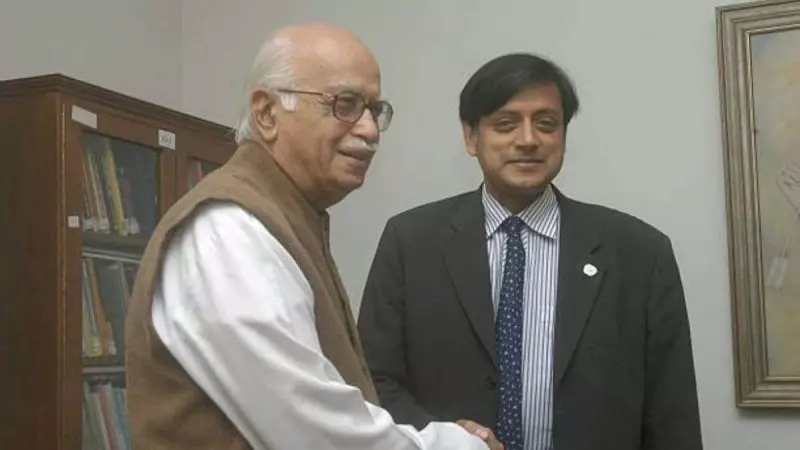
In a remarkable display of political cross-talk, Congress MP Shashi Tharoor has come to the defense of veteran BJP leader LK Advani, drawing unexpected parallels between India's first Prime Minister Jawaharlal Nehru and former PM Indira Gandhi. The intervention came during a television debate that has since sparked significant political discourse.
Historical Context and Political Defense
Tharoor's defense emerged during a heated discussion about political legacies and historical assessment. The Congress leader argued that reducing any political figure's extensive career to a single episode does injustice to their complete contribution. Tharoor specifically referenced how both Nehru and Indira Gandhi faced criticism for certain decisions, yet their overall legacies remain complex and multifaceted.
The timing of Tharoor's comments is particularly significant given the current political climate and the recent consecration ceremony of the Ram Temple in Ayodhya. Advani's Rath Yatra in 1990 remains one of the most defining moments in modern Indian politics, fundamentally altering the country's political landscape and ultimately contributing to the BJP's rise to national prominence.

The Nehru and Indira Gandhi Parallels
Tharoor elaborated on his comparison by noting that historical figures often face oversimplification. "We remember Nehru for the Kashmir issue or the China war, but we forget his role in building modern Indian institutions," Tharoor suggested during the debate. Similarly, he noted that Indira Gandhi's legacy includes both the Emergency period and significant economic and foreign policy achievements.
The Congress MP's argument centers on the danger of reducing decades of public service to singular events, whether positive or negative. This perspective challenges the current political trend where complex legacies are often flattened into simplistic narratives for contemporary political advantage.
Political Reactions and Implications
Tharoor's comments have generated mixed reactions across the political spectrum. Some within his own party have expressed discomfort with the comparisons, while opposition figures have noted the unusual nature of a Congress leader defending a BJP stalwart. The discussion highlights the evolving nature of political discourse in India, where traditional party lines are increasingly being crossed in intellectual debates.
The debate also touches upon the broader question of how historical figures should be evaluated. Tharoor emphasized the importance of contextual understanding rather than selective memory when assessing political contributions spanning several decades. This approach, he suggested, allows for a more nuanced appreciation of India's complex political history.
As Indian politics continues to evolve, such cross-party acknowledgments of historical contributions may signal a shift toward more sophisticated political discourse. However, the immediate reaction suggests that traditional political boundaries remain firmly in place when it comes to public statements and political positioning.