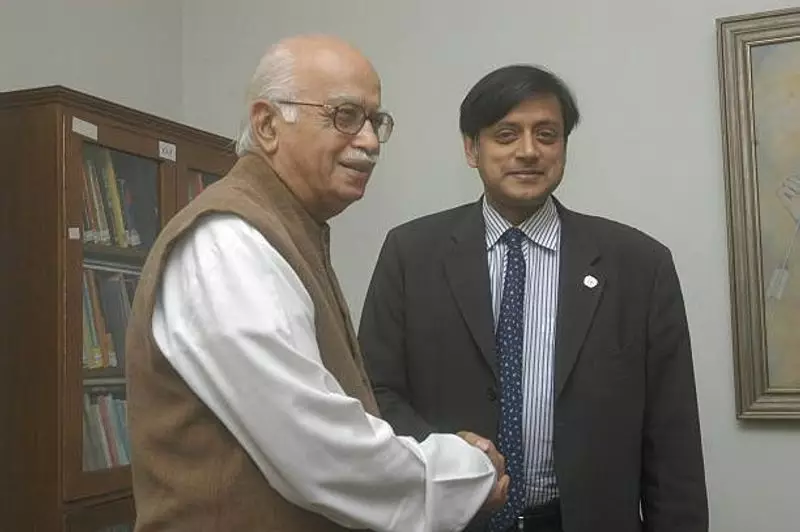
Congress leader Shashi Tharoor has firmly responded to criticism within his party regarding his tribute to BJP veteran LK Advani, stating that reducing the political stalwart's long years of service to just one episode would be fundamentally unfair.
The Controversial Tribute
The controversy erupted when Tharoor, a three-time MP from Thiruvananthapuram, praised Advani following the announcement of the Bharat Ratna award for the 96-year-old BJP leader. In his social media post, Tharoor described Advani as "a great son of India" and acknowledged his decades-long political career.
This gesture did not sit well with some Congress colleagues, who pointed to Advani's central role in the Ram Janmabhoomi movement and the 1992 Babri Masjid demolition. Senior Congress leader AK Antony's son, Anil Antony, was among those who publicly criticized Tharoor's stance, highlighting what he saw as a contradiction in praising a political figure associated with such divisive events.

Tharoor's Detailed Defense
In his comprehensive response, Tharoor elaborated on his position with characteristic nuance. "While I completely understand the sentiments of those who disagree, I believe it's important to acknowledge the entirety of a person's political journey," Tharoor stated.
The former Union Minister emphasized that Advani's career spanned several decades and included significant contributions to Indian politics beyond the Ram Janmabhoomi movement. He pointed to Advani's role as Home Minister and his contributions to parliamentary processes as aspects worthy of recognition.
"To reduce a political career that lasted for over half a century to just one episode, however significant, would be doing injustice to the complexity of Indian political history," Tharoor argued in his defense.
Political Reactions and Implications
The exchange highlights the ongoing tensions within Indian political discourse regarding historical assessment and political reconciliation. Tharoor's approach represents a departure from conventional political rhetoric, where leaders from opposing parties rarely acknowledge each other's contributions.
Political analysts suggest that Tharoor's stance reflects his broader political philosophy of engaging with ideological opponents while maintaining his own convictions. This incident demonstrates the challenges political figures face when attempting to bridge historical divides while remaining accountable to their party's legacy and their constituents' expectations.
The controversy also underscores the continuing sensitivity surrounding the Ram Janmabhoomi movement in Indian politics, even after the Supreme Court's verdict and the subsequent construction of the Ram temple in Ayodhya.
As Indian politics continues to evolve, Tharoor's defense of his position signals a potential shift toward more nuanced political discourse, where acknowledging opponents' contributions doesn't necessarily mean endorsing their entire political agenda.