

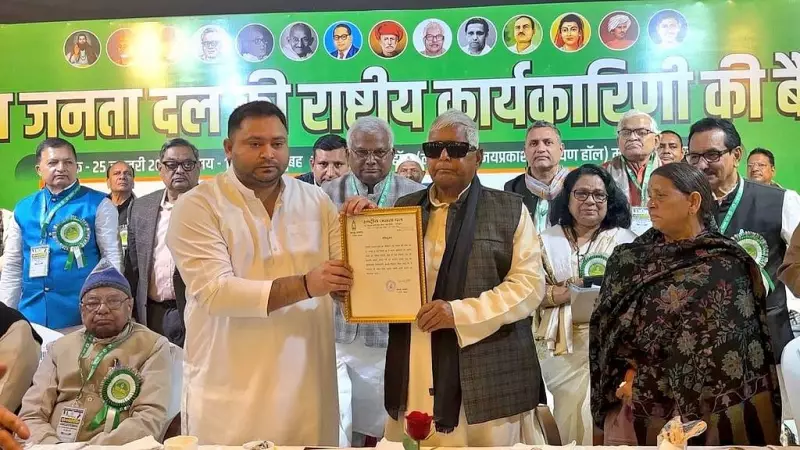
In a landmark development within Indian politics, the Rashtriya Janata Dal (RJD) has officially announced Tejashwi Yadav as its new working president, marking a pivotal transition of leadership from his father, veteran politician Lalu Prasad Yadav. This strategic move signals a generational shift within one of Bihar's most influential political parties, as the baton is passed to the younger Yadav scion.
A New Era for RJD: Tejashwi Yadav Takes the Helm
The appointment was formalized during a crucial party meeting held on January 25, 2026, where senior leaders and members gathered to witness this historic moment. Tejashwi Yadav, who has been a prominent figure in Bihar politics and served as the Leader of the Opposition in the state assembly, now steps into a more central role, poised to steer the party's future direction and electoral strategies.
Family Dynamics and Political Ambitions
Notably, the meeting was attended by Tejashwi Yadav's eldest sister, Misa Bharti, who is the Member of Parliament from Patliputra. Reports had previously suggested that Misa Bharti was also eyeing the position of working president, adding an element of familial intrigue to the proceedings. Her presence at the announcement underscores the unity within the Yadav family despite internal speculations, as the RJD consolidates its leadership under Tejashwi.

The transition comes at a critical juncture for the RJD, which has been a dominant force in Bihar's political landscape for decades. Lalu Prasad Yadav, the party's founder and former chief minister, has been a towering figure, and his decision to pass on responsibilities to his son reflects a calculated move to rejuvenate the party's image and appeal among younger voters. This shift is expected to influence the RJD's approach to key issues such as social justice, economic development, and coalition politics in the run-up to future elections.
Implications for Bihar and National Politics
Tejashwi Yadav's elevation is likely to have far-reaching implications, not only for the RJD but also for the broader political dynamics in Bihar and at the national level. As working president, he will be tasked with strengthening the party's organizational structure, mobilizing grassroots support, and navigating alliances with other political entities. His leadership style, which has often been characterized by a focus on youth empowerment and anti-corruption rhetoric, may bring a fresh perspective to the party's agenda.
Observers note that this move could reshape the opposition landscape in India, particularly in the Hindi heartland, where the RJD plays a significant role. With Tejashwi at the forefront, the party aims to capitalize on his popularity and connect with a wider electorate, potentially challenging incumbent forces in upcoming state and national polls. The announcement has already sparked discussions among political analysts about the future trajectory of the RJD and its impact on coalition politics.
In summary, the appointment of Tejashwi Yadav as the RJD's working president marks a decisive step in the party's evolution, blending legacy with new leadership. As the political scene in India continues to evolve, all eyes will be on how Tejashwi navigates this role and drives the RJD forward in the competitive arena of Indian democracy.






