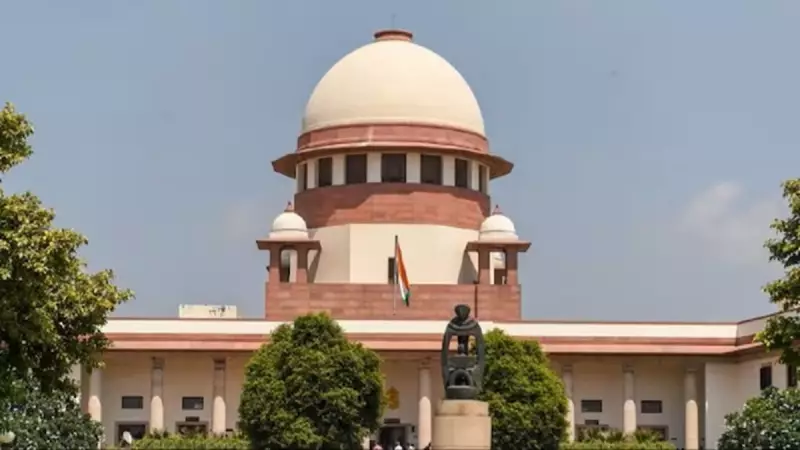
The Supreme Court of India has taken a significant step by formally questioning the constitutional validity of the lifetime immunity granted to the Chief Election Commissioner (CEC) and Election Commissioners (ECs). A bench comprising Justices Sanjiv Khanna and Dipankar Datta issued notices, seeking detailed replies from both the central government and the Election Commission of India (ECI) on this critical matter.
The Core of the Legal Challenge
The apex court's scrutiny stems from a petition that challenges the differential legal protection offered to the CEC and ECs compared to other high constitutional functionaries. The petition argues that this blanket, lifelong immunity from prosecution for acts done in the discharge of official duties is excessive and potentially undermines accountability.
This protection is rooted in Article 324 of the Constitution and is further reinforced by the Chief Election Commissioner and Other Election Commissioners (Conditions of Service) Act, 2021. The Act explicitly states that no court can entertain civil or criminal proceedings against the CEC or an EC for any act done in the execution of their official duties.

The petitioner's contention is that while immunity during the tenure may be necessary for independent functioning, extending it for a lifetime creates an anomalous situation. It places the election commissioners in a uniquely shielded position, even compared to judges of the Supreme Court and High Courts, who do not enjoy such sweeping post-retirement legal protection.
Seeking Responses from Key Authorities
The Supreme Court bench has directed the Union Government, represented by the Ministry of Law and Justice, and the Election Commission of India to file their counter-affidavits. These replies are expected to explain the rationale behind the existing legal framework and justify the need for such absolute and perpetual immunity.
The court's intervention highlights a fundamental debate about balancing two crucial principles:
- Independence of the Election Commission: Ensuring that the commissioners can perform their daunting duties without fear of intimidation or frivolous litigation.
- Constitutional Accountability: Upholding the principle that no public office should be entirely above the law, especially after the individual has demitted office.
The notice was issued in response to a public interest litigation (PIL) filed by lawyer Prabhakar Tiwari. The PIL argues that the lifetime immunity clause is arbitrary and violates the right to equality before the law as enshrined in the Constitution. It suggests that such immunity should be co-terminus with the tenure of the officials to prevent any potential misuse of power.
Implications and the Road Ahead
The Supreme Court's move to examine this provision has far-reaching implications for India's electoral governance. The Election Commission of India is one of the most critical institutions in the world's largest democracy, tasked with conducting free and fair elections. Any legal framework governing its top officials is, therefore, of paramount national importance.
This judicial examination comes at a time when there is increased public and scholarly discourse on electoral reforms and the strengthening of democratic institutions. The court's final interpretation could potentially lead to a legislative rethink or a constitutional clarification regarding the extent of legal protection afforded to the guardians of the electoral process.
The next hearing in this landmark case is awaited, where the arguments from both the Centre and the Election Commission will be closely evaluated. The outcome could redefine the contours of accountability for one of India's most powerful constitutional bodies.