

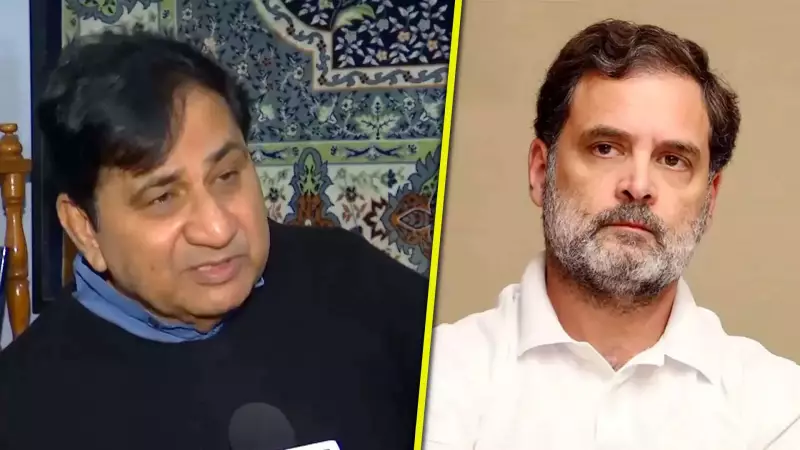
Former Congress Leader Shakeel Ahmad Levels Serious Allegations Against Rahul Gandhi
In a startling revelation that has sent shockwaves through Indian political circles, former Congress leader Shakeel Ahmad has launched a scathing attack on Rahul Gandhi, accusing the party of a complete absence of internal democracy. The veteran politician, who has decades of experience in public service, made these explosive claims in a recent statement that has ignited intense debate about the functioning of one of India's oldest political institutions.
Allegations of Democratic Deficit and Leadership Marginalization
Shakeel Ahmad asserted that senior leaders within the Congress party are systematically being sidelined, creating an environment where dissenting voices are suppressed. He specifically pointed to Rahul Gandhi's alleged discomfort with leaders who do not treat him as their superior, despite many having served the party long before Gandhi's first electoral victory. This criticism highlights what Ahmad perceives as a fundamental flaw in the party's leadership structure.
The former Congress leader further elaborated on his concerns, stating that key decisions within the party are unilaterally dictated by Rahul Gandhi, bypassing traditional consultative processes. He attributed this behavior to what he described as Gandhi's sense of superiority, which he believes stems from the Nehru-Gandhi family lineage that has dominated Indian politics for generations.

Youth Organizations Used to Undermine Senior Leadership
In perhaps his most damaging allegation, Shakeel Ahmad claimed that the Youth Congress and National Students' Union of India (NSUI) have been strategically utilized to marginalize experienced senior leadership. According to his account, these youth wings have been empowered at the expense of veteran politicians, creating internal divisions and weakening the party's institutional memory and strategic depth.
This revelation sheds light on what many political observers have long suspected about power dynamics within the Congress organization, where generational transitions have sometimes created friction between established leaders and emerging voices.
Personal Revelations and Disappointment with Leadership Style
Ahmad made several personal disclosures that added weight to his criticisms. He revealed that during internal party elections, he voted for Mallikarjun Kharge despite personally preferring Shashi Tharoor, suggesting complex internal dynamics and potential pressure within the organization. This admission provides rare insight into the voting behavior of senior party members during crucial internal contests.
The former leader expressed profound disappointment with Rahul Gandhi's approach to party management, particularly noting that Gandhi allegedly avoids meaningful interactions with popular leaders who enjoy substantial public support. According to Ahmad, this isolationist tendency prevents the party from benefiting from diverse perspectives and regional strengths.
Congress as Family Domain: The Core Criticism
At the heart of Shakeel Ahmad's critique lies the accusation that Rahul Gandhi treats the Congress party as a family domain rather than a democratic political institution. This characterization strikes at the fundamental identity of the party, which has historically positioned itself as a broad-based, inclusive political movement representing India's diverse population.
The timing of these allegations is particularly significant as the Congress party navigates challenging political waters and attempts to rebuild its national presence. Such public criticism from a former insider raises serious questions about internal cohesion and could potentially impact the party's efforts to present a united front against political rivals.
As these revelations continue to reverberate through political circles, they highlight ongoing tensions within one of India's most prominent political organizations and raise fundamental questions about democratic practices in political parties across the spectrum.






