Shah Defends Diya Lighting as Social Experiment During Covid Pandemic
Union Home Minister Amit Shah has strongly defended the nationwide lamp lighting initiative during the Covid-19 pandemic. He described it as a deliberate social experiment designed to uplift public morale. Speaking at an event in Gandhinagar, Shah addressed critics who questioned the effectiveness of such symbolic gestures.
"Those who mocked us, asking whether corona would vanish by lighting diyas or ringing bells, failed to understand the purpose," Shah stated firmly. "It was never about magical cures. This was a carefully planned social experiment to raise spirits and foster unity during a terrifying time."
Revisiting India's Pandemic Response
Shah used the occasion to reiterate what he called India's remarkable success story against Covid-19. He recalled the initial global anxiety about India's capacity to handle the crisis, given its healthcare infrastructure challenges at the time.

"Experts worldwide were deeply concerned. In simple terms, they predicted truckloads of bodies in our streets," Shah recounted. "But when the pandemic subsided, history showed that my country fought one of the most effective battles globally."
He highlighted the vaccination drive as a cornerstone of this success. Shah contrasted India's experience with that of other nations, noting the efficiency of the rollout.
"My relatives in America waited three months for a vaccine certificate," he shared. "Here, we vaccinated 140 crore people twice, and certificates with our Prime Minister's smiling face arrived on phones instantly. It was a mission executed with precision."
The "Social Science" Behind the Victory
Shah attributed the victory not just to medicine, but to a unique social framework. He explained that while other countries relied solely on their central governments, India mobilized its entire federal structure.
"The fight was collective," he emphasized. "The central government led, state governments acted, local bodies worked on the ground, and 140 crore citizens came together as one. That is the social science that saved us."
He also revealed that Prime Minister Narendra Modi ordered scientists to begin vaccine development when India had fewer than 300 Covid cases and lacked proper testing facilities. This early move, Shah claimed, resulted in two indigenous vaccines that protected Indians and were shared with over 70 other countries.
Laying the Foundation for Future Health Security
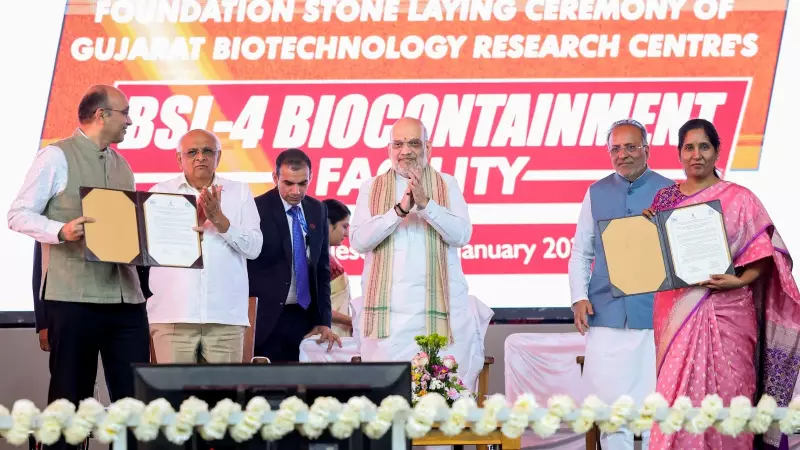
The event marked the foundation-laying ceremony for India's second Biosafety Level 4 (BSL-4) containment facility. This high-security lab is being built in Gandhinagar, Shah's parliamentary constituency, at a cost of Rs 362 crore.
"Today, we enter a new era for India's health security and biotechnology," Shah declared. "This BSL-4 facility will become a vital health shield for our nation."
He noted that this would be the first such top-tier lab developed by a state government, crediting Gujarat for the initiative. The facility, spanning 11,000 square metres, aims to provide permanent, research-based protection against future pathogens.
Addressing Immediate and Future Threats
Shah pointed to recent health crises in Gujarat, like the Chandipura virus and lumpy skin disease, as stark warnings. These outbreaks demonstrated the urgent need for labs exceeding Bio-safety Level 3 capabilities.
"Our goal is not temporary fixes," he asserted. "We seek permanent, scientifically-grounded protection. This new laboratory will fulfill that critical requirement."
Showcasing India's Biotech Boom
The Home Minister presented impressive figures to illustrate the growth of India's biotechnology sector over the past decade. He stated that the country's bio-economy skyrocketed from $10 billion in 2014 to over $166 billion by the end of the 2024 financial year.

- The number of biotech startups surged from under 500 to more than 10,000.
- Bio-incubators increased from 6 to 95.
- Incubation space expanded fifteen-fold.
- Market products grew from 10 to over 800.
- Patent filings jumped from 125 to 1,300.
- Private investment soared from Rs 10 crore to Rs 7,000 crore.
"These numbers prove our youth and industrialists have immense potential," Shah concluded. "They simply need the right infrastructure and government support to excel. This lab is a step in that very direction."
Shah also briefly mentioned the ongoing Genome India Project and reiterated the Prime Minister's focus on combating Antimicrobial Resistance, positioning vaccine development and manufacturing as key national priorities.