Supreme Court Intervenes in ED Raid Controversy, Halts Police Action
The Supreme Court of India has stepped into a heated political and legal dispute involving West Bengal Chief Minister Mamata Banerjee and the Enforcement Directorate. On Thursday, the court issued a formal notice to Banerjee and other respondents while staying all further proceedings in FIRs registered by West Bengal Police against ED officials.
Court Raises Fundamental Questions About Agency Independence
A bench comprising Justices P K Mishra and Vipul M Pancholi expressed deep concern about what it termed a serious issue relating to investigations by central agencies. The court questioned whether state agencies could obstruct central investigative bodies under the guise of protecting party activities.
"Prima facie view that the present petition has raised a serious issue relating to the investigation by the Enforcement Directorate or other central agencies and its interference by state agencies," the bench stated clearly.

Preservation of Evidence Ordered
The Supreme Court directed authorities to preserve all CCTV footage and other devices containing recordings of the search operations. This preservation order ensures that crucial evidence remains available for proper judicial examination as the case progresses.
The bench emphasized the importance of maintaining rule of law across the country. "For adherence to rule of law in the country and to allow each organ to function independently, it is necessary to examine the issue," the justices observed.
Background of the I-PAC Raids
The controversy stems from January 8 raids conducted by the Enforcement Directorate at multiple locations linked to I-PAC, the political consultancy firm managing the Trinamool Congress's election campaign. These searches were part of an investigation into alleged coal smuggling and money laundering activities.
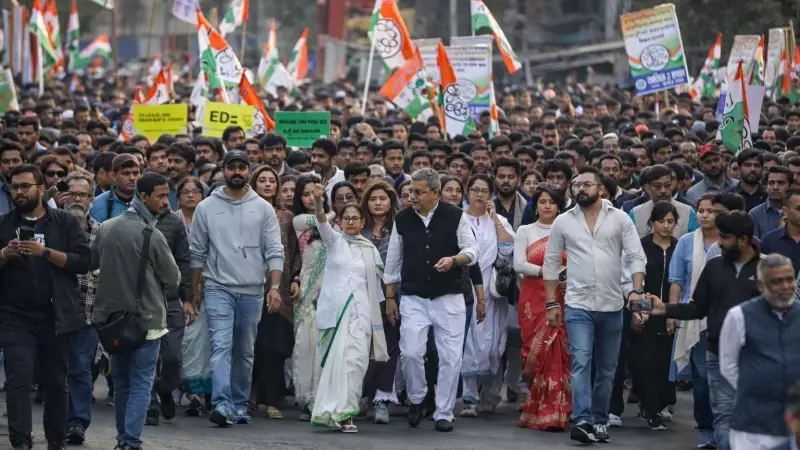
During the searches, Chief Minister Mamata Banerjee arrived at the residence of I-PAC director Pratik Jain. She subsequently walked out carrying a laptop and a green folder. Banerjee also visited I-PAC's office and removed several files from the premises.
Court's Concerns About Federal Structure
The Supreme Court bench highlighted broader constitutional questions at stake. "Larger questions have been raised and are involved in the present matter," the court noted, warning that unresolved issues could lead to worsening situations and potential lawlessness in various states.
While acknowledging that central agencies cannot interfere with legitimate party election work, the bench posed a critical question: "If the central agencies are acting bonafide to investigate any serious offence, the question arises as to whether taking shield of its party activity, the agencies can be obstructed from carrying out their investigating power in a bonafide manner."
Rejection of State's Arguments
Senior Advocate A M Singhvi, representing West Bengal authorities, urged the court to avoid staying proceedings and instead suggest no coercive actions. The bench firmly rejected this approach.
Justice Mishra responded decisively: "If they were armed with an authorisation, they were acting in good faith." This statement reinforced the court's position on protecting legitimate investigative actions.
Displeasure Over Court Disruptions
The Supreme Court also expressed strong disapproval of chaotic scenes that forced the Calcutta High Court to adjourn hearings on January 14. "We are very much disturbed... Today it is this HC, tomorrow it may be some other HC," Justice Mishra remarked, indicating concern about maintaining judicial decorum and functionality.
Legal Proceedings Continue
Both the Enforcement Directorate and the Trinamool Congress had approached the Calcutta High Court earlier. On Wednesday, the high court disposed of TMC's petition seeking protection of "private and confidential political data" after the ED submitted that it had not seized any materials during the raids.
The Supreme Court's intervention now places this politically sensitive case at the national judicial level, where fundamental questions about federal investigative powers and state agency interference will receive thorough examination.