Saraswati Puja and Friday Namaz Converge at Bhojshala Under Heavy Security Shadow
The Supreme Court's directive on Thursday paved the way for a historic convergence at the Bhojshala Temple/Kamal Maula Mosque complex in Madhya Pradesh's Dhar district. On Friday, Basant Panchami celebrations and Friday namaz occurred simultaneously under an unprecedented security blanket, marking a significant moment in the long-standing dispute over this 11th-century monument.
Supreme Court's Intervention and Security Preparations
In response to a plea by the Hindu Front for Justice (HFJ), the Supreme Court issued directions to allow both Hindu devotees and Muslim worshippers to conduct their rituals at the Archaeological Survey of India-protected site. This decision came just a day before Basant Panchami, a spring festival dedicated to Goddess Saraswati, coincided with Friday prayers for the first time in a decade.
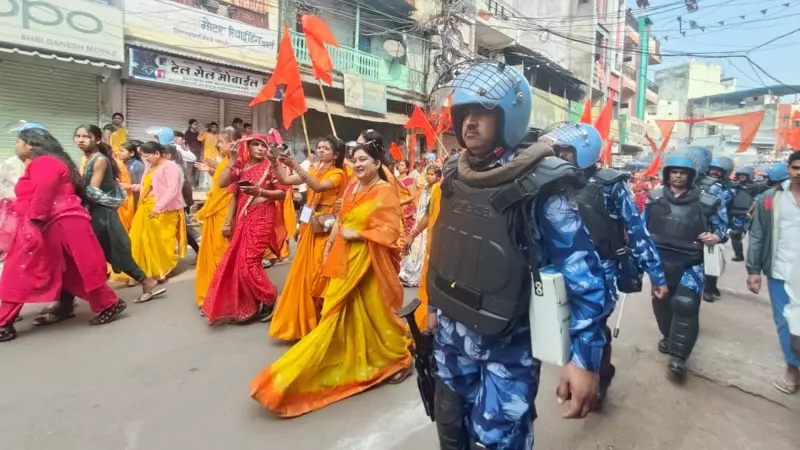
The Dhar administration left nothing to chance. Over 8,000 police officers were deployed from surrounding regions, supported by eight Rapid Action Force platoons and 933 women police personnel. The city was mapped in 3D, with police monitoring live feeds from a central control room. More than 20 AI-enabled drones conducted regular aerial surveillance, providing real-time data on crowd density. Armored vehicles stood ready, and officers with automatic weapons maintained tight perimeters around the complex.

A Day of Contrasts and Controlled Devotion
From dawn, narrow approach roads to Bhojshala turned saffron as thousands of Hindu devotees joined processions. Triangular flags fluttered from bamboo poles, while young men in white kurtas raised slogans and women in vibrant saris moved in clusters, clapping rhythmically. DJ-mounted vehicles blared "Chalo Bhojshala" as various outfits advanced toward the complex.
In stark contrast, Muslim worshippers offered Friday prayers in a more subdued manner. Approximately 15-17 individuals were brought through a back gate, wearing volunteer jackets to blend with security personnel. They were escorted to a designated spot where the dome was concealed with a white cloth. Dhar Collector Priyank Mishra confirmed that both communities conducted their rituals peacefully as per the Supreme Court order.
Voices from the Ground: Rights, Rituals, and Dissent
Among the devotees, Shantilal, waiting with his ten-year-old son, emphasized rights over rituals. "The Supreme Court has allowed both communities to enter today," he said quietly. "We don't pay much attention to Hindu-Muslim issues. All we want is the right to pray the whole day in our Saraswati mandir."
Others, like Shivani, visiting Bhojshala for the first time, turned back due to the overwhelming crowd. "There is too much of a crowd," she explained. "I came because of the mahaul around Friday namaz. Basant Panchami is bigger than ever this time, but I can't risk bringing my children into such a huge gathering."
However, not all voices were harmonious. Imran Khan, one of those selected for namaz, alleged administrative failure. He claimed officials met them late the previous night, promised escort to the mosque, but later left them near the site with a single watchman. "We were 15-20 people in total, and we could not read the namaz," he asserted. "The administration cheated us." Collector Mishra dismissed these allegations, reiterating that prayers were conducted as planned.
Historical Context and Evolving Dispute
The Bhojshala dispute traces back to the early 2000s when right-wing groups began demanding:
- Closure of the mosque
- Ban on Friday namaz
- Installation of a Saraswati idol in the complex
In April 2003, the ASI arranged a compromise where Hindus would perform puja on Tuesdays and Muslims would offer namaz on Fridays. This arrangement was challenged in a PIL filed by HFJ on May 2, 2022, which argued that Hindus should have daily worship rights, citing historical claims that a Saraswati statue was installed in 1034 and later taken to London in 1857.
The Madhya Pradesh High Court ordered an ASI survey in 2024 to "demystify" the site's nature. The subsequent report stated that the existing structure was made from parts of earlier temples, fueling further debate.

Political Dimensions and Changing Perceptions
Alok Kumar, international president of the Vishwa Hindu Parishad, framed the issue as one of encroachment rather than religion. "The battle of Dhar is the battle of the whole country," he declared adjacent to the disputed site. "This is the battle of the whole Hindu society, and we have to fight this battle together."
Local residents noted the transformation over years. Sitaram, a 57-year-old businessman, observed: "The crowds are huge, the security is unprecedented. We never had so much political spotlight on the issue. Earlier, temple demands were raked up during elections and forgotten. Now it's a permanent position of the people."
Young participants like Rajesh, Gopal, and Kartik, polytechnic students, felt Bhojshala had evolved from a local concern to a national issue. "After the ASI said the structure was made from reused temple parts, it's hard to ignore," one remarked.
Looking Ahead: Peace, Prosperity, and Continued Dialogue
Gunjan Pipilofiya expressed a common sentiment among devotees: "The court order is good, but we want access the whole year now. We have nothing against the Muslim community." This reflects a desire for sustained resolution rather than temporary arrangements.
As Basant Panchami concluded and Friday prayers ended, the day stood as a testament to judicial intervention and administrative coordination. Yet, underlying tensions and historical claims ensure that Bhojshala remains a focal point for discussions on heritage, faith, and coexistence in contemporary India.