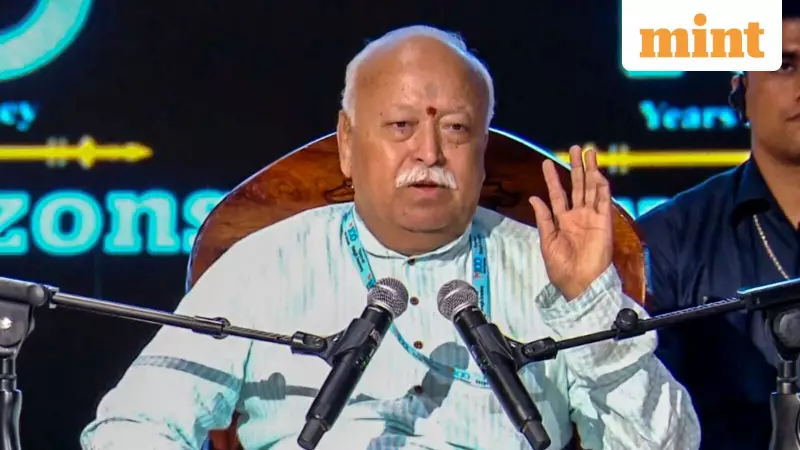
In a significant address that has sparked national conversation, Rashtriya Swayamsevak Sangh (RSS) Chief Mohan Bhagwat articulated a vision of conditional inclusivity for India's diverse communities within the Sangh's fold. Speaking at a two-day lecture series in Bengaluru titled "100 Years of Sangh Journey: New Horizons", Bhagwat laid out the organisation's stance on membership and national identity.
A Clarification on Sangh Membership
Mohan Bhagwat directly addressed the perception of exclusivity within the RSS, offering a nuanced perspective. "No Brahmin is allowed in Sangh. No other caste is allowed in the Sangh. No Muslim is allowed, no Christian is allowed in the Sangha. Only Hindus are allowed," he stated, before immediately clarifying this point. He explained that individuals from all denominations, including Muslims and Christians, are welcome to participate in the Shakhas (branches) under one fundamental condition: they must shed their sense of separateness.
"So people with different denominations, Muslims, Christians, any denomination, can come to the Sangha but keep your separateness out," Bhagwat elaborated. He emphasized that the RSS does not categorize its participants by caste or religion, focusing instead on a unifying principle. "We don't take their count, and we don't ask who they are. We are all sons of Bharat Mata. That is how Sangha works," he added, framing the Sangh's approach as one rooted in a shared national identity.

Defending the RSS's Legal and Constitutional Standing
Another key point in Bhagwat's lecture was a robust defence of the RSS's registration status, a topic of recent public debate. He provided a historical context, reminding the audience that the organisation was founded in 1925 during the British Raj. "Do you expect us to register with the British government? Against whom?... We were banned thrice. So, the government has recognised. If we were not there, who would they ban?" he questioned.
He further asserted that the courts had resolved these bans, ultimately establishing the RSS as a legal organisation. Dismissing the need for formal registration, Bhagwat stated, "Legally, factually, we are an organisation. We are not unconstitutional. We are within that constitution. Our legal status is within that constitution. So we need not register. Many things are there which are not registered. Even Hindu Dharma is not registered..."
The Core Vision: An Organised Hindu Society for a Strong India
Elaborating on the long-term mission of the RSS, Mohan Bhagwat connected the empowerment of Hindu society with national and global prosperity. He articulated that the Sangh's primary goal is to foster unity and impart qualities across the entire Hindu community.
"We want to unite, organise, impart qualities to the entire Hindu society so that they will create a prosperous and strong Bharat which will impart the Dharma knowledge to the world," he said. He unequivocally defined the organisation's mission: "Our mission, our vision is an organised, strong Hindu society." This vision, according to Bhagwat, is not just for India's benefit but to guide the world toward peace and happiness through the principles of Dharma.
Concluding his address on a note of national symbolism, Bhagwat also addressed questions regarding the RSS flag and the Indian national flag, the Tiranga. He affirmed the Sangh's unwavering respect for the Tricolour, noting that while the traditional Bhagwa Dhwaj was once proposed as the national flag, the organisation has always stood by and protected the Tiranga. "Since its creation, Sangha has always stood by, respected, offered tributes and protected this Tiranga Dhwaj... There is no question of Bhagwa vis-a-vis Bhagwa and Tiranga," he stated, putting to rest any speculation of a conflict between the two symbols.