Riley Gaines Questions Trump's AI Image, Then Quickly Reaffirms Support
Former competitive swimmer Riley Gaines sparked a brief but intense online controversy when she criticized former President Donald Trump over a controversial AI-generated image he shared on Truth Social, only to reverse her stance within hours after Trump publicly responded to her comments.
The Initial Criticism: A Call for Humility
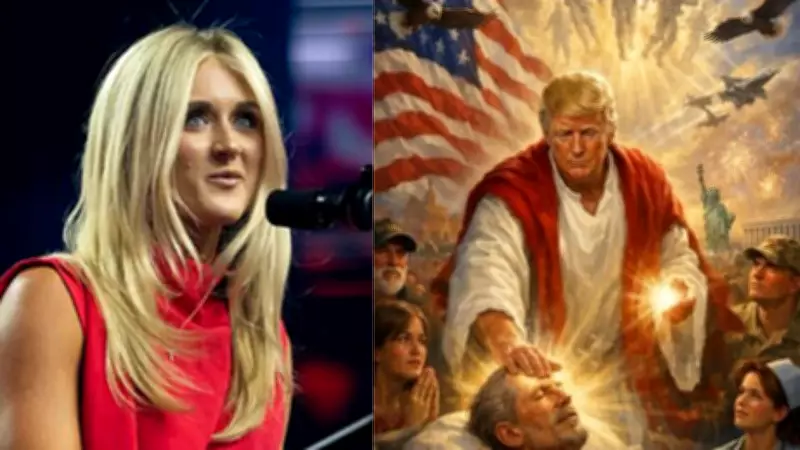
The situation began when Donald Trump posted an AI-created image on his Truth Social platform that many online observers interpreted as depicting him in a manner reminiscent of religious iconography. Riley Gaines, who has been a vocal Trump supporter in the past, took to X (formerly Twitter) to express her disapproval.
In her initial post, Gaines wrote: "Why? Seriously, I cannot understand why he'd post this. Is he looking for a response? Does he actually think this?" She didn't stop there, adding a pointed critique: "Either way, two things are true. 1) a little humility would serve him well. 2) God shall not be mocked."

Her comments quickly gained traction across social media platforms, particularly given her history of staunch support for Trump and his political agenda. The swift backlash highlighted the sensitive nature of the AI image and its perceived implications.
The Swift Reversal: Renewed Support for Trump
Just hours after her critical posts, Riley Gaines made a dramatic about-face, posting a new message that reaffirmed her support for the former president. She wrote: "I love the President and I'm so grateful he's in the Oval Office. Of course, I'll continue to support him and the America First agenda."
Gaines attempted to clarify her position, explaining: "Our purpose on this earth is to glorify Him in all we do. The truth social post missed the mark. It's now deleted. Amazing! We're imperfect people. I know I am." This rapid shift from criticism to support left many observers questioning what prompted such a sudden change in tone.
Trump's Response: "Not a Big Fan"
The answer came during a phone interview Donald Trump gave to CBS News reporter Norah O'Donnell. When asked about Gaines' criticism, Trump made his position clear: "I didn't listen to Riley Gaines. I'm not a big fan of Riley, actually."
Trump offered his interpretation of the controversial image, stating: "I viewed that as a picture of me being a doctor in fixing, you had the Red Cross right there, you had, you know, medical people surrounding me." According to Trump, the post was removed not because of backlash or Gaines' criticism, but because people had misunderstood its intended meaning.
Historical Context of Their Relationship
This brief clash stands in stark contrast to the previously strong relationship between Gaines and Trump. In February 2025, Trump invited Gaines to the White House and publicly praised her during an event focused on women's sports, calling her a "brave swimmer" and thanking her for her advocacy work.
Gaines has consistently supported Trump at political rallies and during his 2024 presidential campaign, making this temporary rift particularly noteworthy. The episode demonstrates how quickly political alliances can be tested in the age of social media controversies.
Broader Implications
This incident highlights several important dynamics in contemporary politics:
- The power of AI-generated content to spark political controversies
- The delicate balance between personal conviction and political loyalty
- The rapid pace at which social media controversies can develop and resolve
- The challenges public figures face when navigating religious sensitivities in political discourse
While the conflict between Gaines and Trump appears to have been short-lived, it serves as a reminder of how quickly political narratives can shift in the digital age, and how complex relationships between public figures can become when tested by controversial content.