Republic Day Reflections: Letters to Dr. Ambedkar on Gratitude and Unresolved Struggles
As India prepares to celebrate Republic Day, a poignant tradition emerges where authors, illustrators, and artists pen heartfelt letters to Dr. B.R. Ambedkar, the chief architect of the nation's Constitution. These letters serve as a powerful medium to express gratitude for the transformative changes he set into motion while candidly apprising him of the societal issues that remain stubbornly unchanged. This year, three distinct voices from Delhi and Hyderabad share their personal tributes, blending admiration with critical introspection.
'Every Time I Draw You, I Feel Less Alone': A Personal Tribute from an Artist
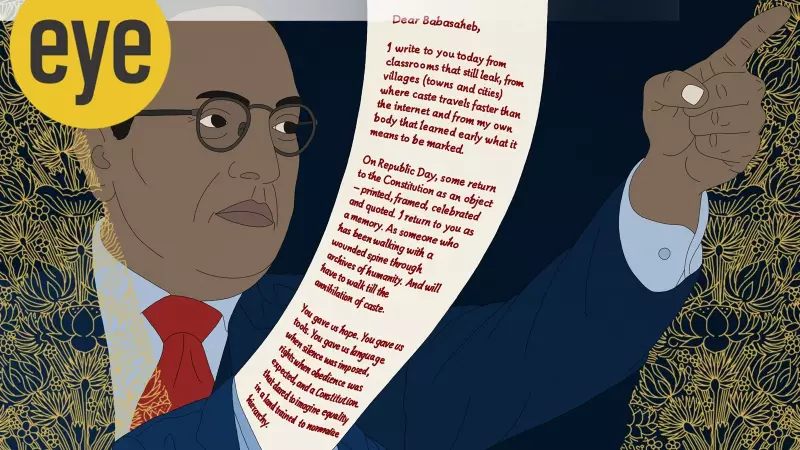
In a deeply moving letter, Siddhesh Gautam, a multi-disciplinary artist based in Delhi, addresses Babasaheb from the stark realities of contemporary India. He writes from classrooms that still leak, from villages, towns, and cities where caste prejudice travels faster than the internet, and from his own body that learned early the harsh lessons of being marked by societal hierarchies.
While many return to the Constitution as a celebrated object on Republic Day, Gautam returns to Ambedkar as a living memory—a companion walking through archives of humanity with a wounded spine, a journey that must continue until the annihilation of caste is achieved. He acknowledges the hope, tools, and language that Ambedkar provided, empowering marginalized communities with rights and a vision of equality in a land historically trained to normalize hierarchy.

However, Gautam does not shy away from posing difficult questions. He wonders if Ambedkar foresaw how caste would learn to hide insidiously within universities, liberal vocabularies, development projects, and art institutions. He reflects on the irony of Ambedkar's image being turned into statues while his radical ideas are often treated as an inconvenience. Despite progress, manual scavenging persists, campuses punish Dalit assertion, and representation remains tokenized rather than transformative. The Republic exists, but fraternity remains fragile.
Yet, amidst these challenges, Gautam expresses profound gratitude. Every time he draws Ambedkar, writes about him, or speaks his name in public, he feels less alone. Ambedkar taught him that dignity is not a favor but a right, and that memory itself can be a potent form of resistance. The letter concludes with a resolve to keep walking, often limping and tired, but moving forward because Ambedkar showed the way.
'You Are a Source of Strength in Moments of Despair': An Author's Perspective
Anurag Bhaskar, author of The Foresighted Ambedkar, pens a letter that resonates with millions whose lives have been transformed by Ambedkar's legacy. He begins with a powerful affirmation: We are, because you were. Ambedkar did not merely draft the Constitution; he foresaw a fairer future and built safeguards for those who had never been protected before, altering the moral direction of an entire nation.
For many, Ambedkar's presence extends beyond history books, serving as a source of strength in moments of despair and a voice of reason when society seeks to ridicule or erase marginalized voices. His life and ideas bestowed not only rights but also dignity, teaching that self-respect is non-negotiable. When the weight of social hierarchy feels overwhelming, Ambedkar's example reminds us that resistance is both possible and necessary.
Bhaskar highlights how Ambedkar led by example, demonstrating that courage lies in standing in solidarity with what is right, that protest is constitutional, and that silence in the face of injustice is itself an injustice. The affirmative action Ambedkar argued for has undeniably transformed lives, opening doors to education, employment, and political participation.

Yet, Bhaskar acknowledges that Ambedkar's fears have proven true. The appeal to cultivate constitutional morality has not been fully honored, with leaders disregarding conventions and citizens placing caste loyalties above fraternity. Seventy-five years on, India still grapples with basic guarantees like quality education, accessible healthcare, and inclusion within institutions of power. Inequality persists in newer, more sophisticated forms, and Ambedkar's warnings about minority safeguards and institutional checks were often sidelined, even in his own time.
The letter emphasizes that the responsibility placed upon citizens is Ambedkar's greatest legacy. The path forward requires sustained political education, collective mobilization, and a refusal to treat the Constitution as a finished text. On this Republic Day, Bhaskar thanks Ambedkar not only for what he gave but for the courage he demanded from every citizen.
'Your Courage Instilled Confidence in Me': An Artist's Journey Inspired by Ambedkar
Madhukar Mucharla, a Hyderabad-based artist, writes a letter of deep respect and gratitude, reflecting on how Ambedkar's life and writings have shaped his thinking, work, and understanding of society. Mucharla's art centers on leather, a material he began exploring during his masters in Fine Art, inspired by its association with Dalit history and labour.
He shares that he owes this artistic medium to Ambedkar, whose writings inspired him to reflect on his personal history as a Dalit and speak about the collective histories of the community. While he learned about the Constitution in school, it was in college that he delved deeper into Ambedkar's thoughts, finding in them a powerful source of strength and conviction.
Reading Ambedkar's autobiography helped Mucharla understand the lifelong fight against caste injustice and gender inequality. Ambedkar's courage in questioning caste and social hierarchy moved him deeply and instilled the confidence to challenge similar oppressions. Inspirations from events like the Mahad Satyagraha and the burning of the Manusmriti taught him to challenge injustice directly and fearlessly.
Growing up in Nandiwanaparthy, Telangana, Mucharla witnessed discrimination firsthand, with lower castes subjected to exclusion and insult. He often assisted his father in leather work, a task shunned by the upper caste. At the time, he felt too little had been done to secure justice, but now he appreciates the complex battles Ambedkar fought.
As an artist, Mucharla has faced caste-based discrimination, but Ambedkar's writings helped him understand that this stigma stems from deep-rooted societal prejudice, not the material or himself. Through his art, he aims to transform a stigmatized material, speaking about equality, labour, and identity, and giving visibility to oppressed communities. His goal is to remove the stigma attached to leather craft and celebrate its history in a contemporary way.
Mucharla concludes by thanking Ambedkar for providing knowledge, courage, and clarity, enabling him to understand society better and share that understanding through his art. Ambedkar's vision continues to guide his path, a testament to the enduring impact of his teachings.
Conclusion: A Legacy of Hope and Ongoing Struggle
These letters, penned ahead of Republic Day, encapsulate the dual nature of Ambedkar's legacy—a source of immense gratitude for the constitutional framework and social tools he provided, coupled with a sobering acknowledgment of the unfinished struggles against caste discrimination and inequality. They remind us that while progress has been made, the journey towards true fraternity and justice is ongoing, requiring continuous effort and reflection from every citizen. As India celebrates its Republic, these voices urge a recommitment to the principles of equality and dignity that Ambedkar championed, ensuring his vision remains alive in both memory and action.