Republic Day: Celebrating India's Living Constitutional Project Renewed by Public Participation
As India marks another Republic Day, it is worth reflecting on constitutional authority as a collective and ongoing project of public engagement, rather than as an initiative solely of the state and merely witnessed by the people as imperial technologies of governance once sought to produce. Republic Day, besides commemorating a moment of state founding, is also an invitation to see the republic as a living, collective project continually renewed through public participation.
The Foundation of Popular Sovereignty
The Constitution of India came into force 76 years ago, representing a pivotal moment in the nation's history. For visionary leaders like Jawaharlal Nehru, the adoption of a republican form of government was the natural culmination of the anti-colonial struggle. The Preamble's opening words, "We the People of India," powerfully underline this democratic ethos. As Nehru declared while introducing the Objectives Resolution in the Constituent Assembly on December 13, 1946, "A free India can be nothing but a republic."
Republic Day thus marks the deliberate choice of the Constituent Assembly to reject monarchical and colonial authority and affirm the principle of popular sovereignty as the foundation of the Indian state. This foundational moment represents a conscious departure from imperial governance structures toward a system where power derives from the people themselves.

Evolution of Republic Day Celebrations
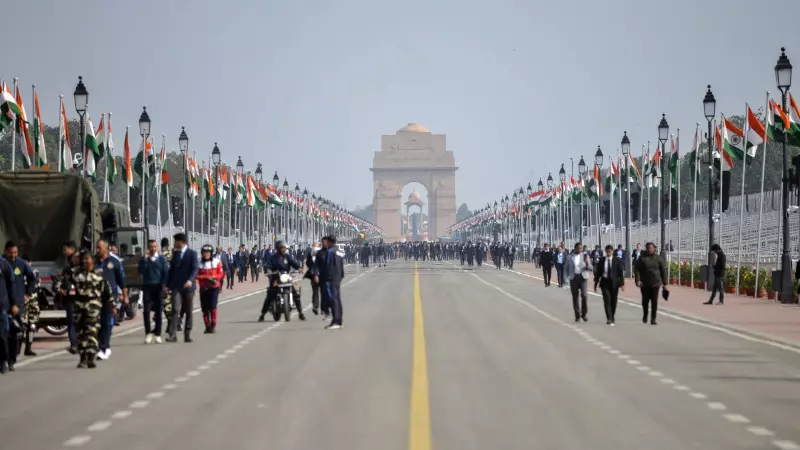
The day has long been an important occasion for national reflection and celebration. The inaugural Republic Day celebrations on January 26, 1950, took place at the Irwin Amphitheatre (now the Major Dhyan Chand National Stadium) in New Delhi. By 1955, the venue had moved to Rajpath (now Kartavya Path), establishing what would become an enduring tradition.
As scholars such as Srirupa Roy observe, these ceremonies were complemented by various symbolic gestures including:
- Issuing commemorative postage stamps
- Declaring a paid public holiday
- Granting amnesties to prisoners
The celebrations, now spectacular in scale, translated Nehru's ideas about synthesising modernity and tradition and combining imperial conventions with popular nationalist forms of expression. These included:
- Ceremonial grandeur and military display
- Allegiance to the sovereign
- Morning processions (prabhat pheris)
- Patriotic songs and flag hoisting ceremonies
From 1952 onward, military displays were followed by cultural pageantry featuring tableaus representing distinctive cultural practices such as festivals, dances, and weddings. This visual assertion of "unity in diversity" became a hallmark of Republic Day celebrations, helping consolidate a particular imagery of national belonging where the state appears not only as the organiser but also as the principal protagonist of the republic's founding memory.
Public Participation in Constitutional Development
The state's centrality in these celebrations invites deeper reflection about the nature of public participation in India's constitutional trajectory. As historian Salmoli Choudhuri's works demonstrate, the "public" was posited as outside the fold of the unrepresentative and inaccessible colonial state in the imagination of nationalist and anti-caste leaders.
In their distinct ways, visionary leaders imagined the public as a space where strangers could live together harmoniously:
- For Mahatma Gandhi, through friendship between people belonging to different religions
- For B R Ambedkar, through fidelity to law as an emancipatory framework
- For Rabindranath Tagore, through law supplemented by ethical culture and literature
Thus, the public was conceived as a "differentiated unity," grounded in friendship, law, and literary and ethical practice rather than kinship, caste, or religious fraternity. Reconstituting the public after colonial intervention was central to the deliberations of India's Constituent Assembly, as the works of Madhav Khosla and Rochana Bajpai show.

Beyond Elite Constitution-Making
Recent scholarship has fundamentally challenged conventional views of India's Constitution-making as an elite, top-down process. Emerging research by historians such as Rohit De and Ornit Shani has revealed that India's constitutional founding involved vigorous and often critical engagement between constitution makers and representatives of various groups and communities.
Between 1946 and 1949, as the Constituent Assembly deliberated on drafting the Constitution, it received thousands of letters, telegrams, and petitions from remarkably diverse publics including:
- Representatives of political organisations and religious groups
- Merchants, teachers, and lawyers
- Individuals writing in their personal capacity
These communications sought various forms of engagement:
- Representation in Constituent Assembly committees
- Protections and safeguards for specific communities
- Suggestions and amendments to the document presented by the Drafting Committee
The public was thus an active constituent in making this historic moment rather than a passive spectator. This participatory dimension challenges the notion that constitutional authority resides solely with state institutions.
Republic Day as Ongoing Democratic Engagement
State celebrations, while spectacular, are not devoid of popular meaning. The shared act of watching Republic Day celebrations whether from the stands at Kartavya Path or through broadcasts in homes carries deep emotional resonance for millions of Indians.
Yet it is crucial to recall that the Indian public was not merely a passive audience to constitutional founding. Instead, it was an active participant in its making, as demonstrated by scholarship from researchers like Achyut Chetan that moves beyond focusing solely on the Constitution's "founding fathers."
The constitutional process represents an ongoing project of public engagement rather than a state initiative merely witnessed by the people. The participation of diverse publics whose engagements both supportive and critical have been integral to India's constitutional life throughout its history.
Republic Day therefore serves dual purposes: commemorating a foundational moment of state creation while simultaneously inviting citizens to see the republic as a living, collective project continually renewed through public participation. This perspective transforms Republic Day from mere historical remembrance to active democratic engagement with India's constitutional future.