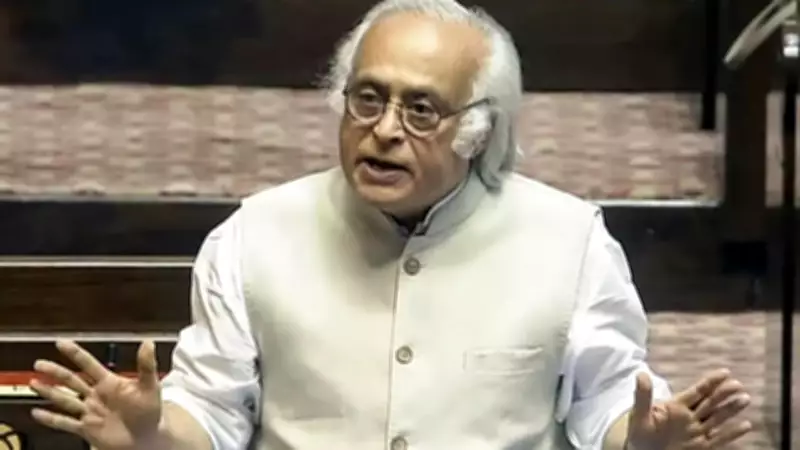
Congress Leader Jairam Ramesh Slams Modi Government Over US-Iran Talks in Pakistan
Congress leader Jairam Ramesh on Saturday launched a sharp critique of Prime Minister Narendra Modi's administration, questioning its inability to stop Washington from granting Islamabad a pivotal role in mediating between the United States and Iran. This criticism emerged following the arrival of US Vice President JD Vance in Islamabad to lead crucial negotiations with an Iranian delegation, aimed at stabilizing a fragile ceasefire and exploring a broader peace process in West Asia.
Ramesh Raises Diplomatic Concerns Amid Peace Hopes
Reacting to the development, Ramesh expressed hope for peace but voiced significant concerns over India's diplomatic positioning. In a post on X, he wrote: "The US-Iran meeting is beginning today in Islamabad. The entire world, including India, are hoping that this is the beginning of a durable peace process between the two countries that will not get derailed by Israel’s continuing aggression in its neighbourhood."
He then questioned the government's foreign policy approach, referring to what he termed the Prime Minister's 'huglomacy'. "But serious questions about the substance and style of the self-declared Vishwaguru’s huglomacy arise," he added.

Four Key Questions Posed by the Congress Leader
The Congress leader raised four critical questions over the situation:
- How has Pakistan managed to carve out a new role for itself despite its involvement in the dastardly Pahalgam terror attack of April 2025 and India's diplomatic efforts to isolate it post-attacks? Ramesh highlighted that this failure is particularly damning, noting that the Dr. Manmohan Singh Government had effectively isolated Pakistan after the Mumbai terror attacks in November 2008.
- How has India allowed the US to accord Pakistan this new role despite high-profile engagements like 'Namaste Trump', 'Howdy Modi', and 'Phir Ek Baar Trump Sarkar' campaigns? He pointed out that India agreed to a one-sided trade deal, giving more than it received, yet the Modi Government failed to gain any leverage with the US.
- Why didn't India, as the current President of BRICS+, launch any peace or mediation initiative, especially since Iran, the UAE, and Saudi Arabia are members of BRICS+? This question underscores missed diplomatic opportunities.
- What has India gained from its calibrated capitulation to China in the past eighteen months, considering China's pivotal role in Pakistan's response to Operation Sindoor and its continued support for Pakistan? Ramesh linked this to broader strategic failures.
He concluded, "Peace in West Asia must return quickly. The Strait of Hormuz must once again revert to the situation that prevailed before the US-Israel assault on Iran began on Feb 28th - a mere two days after Mr. Modi had completed a most ill-advised and ill-timed visit to Israel."
Background and Diplomatic Tensions
Ramesh's remarks come amid heightened diplomatic tensions linked to the ongoing conflict, which began after US and Israeli strikes on Iran in late February. The war has disrupted global energy flows, particularly through the Strait of Hormuz, pushing up oil prices and increasing pressure for a negotiated settlement.
The Congress leader alleged that India failed to leverage its ties with Washington despite high-profile engagements. The talks in Islamabad are occurring under tight security, with roads sealed and movement restricted in parts of the city. Pakistan Prime Minister Shehbaz Sharif has described the negotiations as a "make-or-break" moment for regional stability.
Details of the Islamabad Talks
The Iranian delegation, led by Parliament Speaker Mohammad Bagher Qalibaf and Foreign Minister Abbas Araghchi, is expected to push for key conditions, including a ceasefire in Lebanon and the release of blocked Iranian assets. US Vice President JD Vance, ahead of the talks, warned Tehran against attempting to exploit the negotiations but also expressed cautious optimism about a positive outcome.

These developments unfold against continued tensions in the region, particularly in Lebanon, and ongoing disruptions in the Strait of Hormuz, which carries nearly 20% of the world's energy supply. Ramesh has been a vocal critic of the government's handling of the conflict, previously accusing the Centre of remaining silent on the US-Israel strikes and failing to take meaningful diplomatic initiatives to de-escalate the situation.