Rajya Sabha Elections Expose Deepening Cracks in Opposition INDIA Alliance
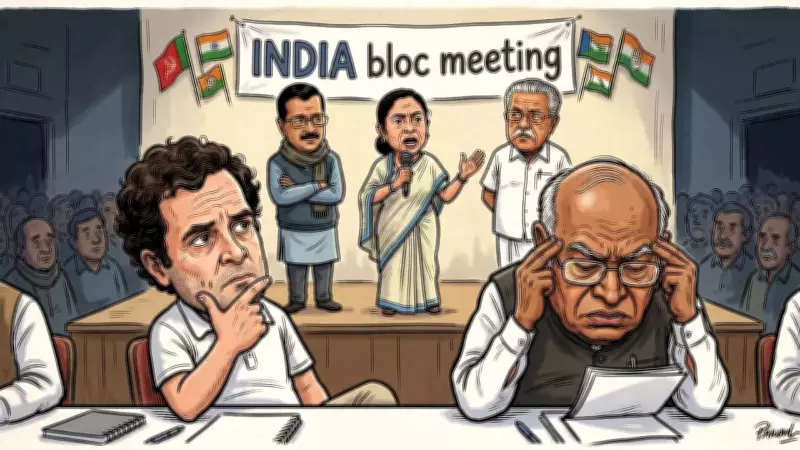
The recently concluded Rajya Sabha elections have done far more than simply reshuffle the numerical composition of the Upper House. This critical electoral exercise has starkly illuminated the widening and increasingly public divide within the opposition's INDIA bloc, formally known as the Indian National Development Inclusive Alliance.
What was originally stitched together as a united opposition front, spearheaded by the Congress party to challenge the BJP ahead of the 2024 Lok Sabha elections, now appears visibly frayed and fragmented. Allies within the coalition are increasingly turning their fire inward, with the Congress party itself finding itself at the epicenter of this political heat.
Allies Turn Critics in Unprecedented Rhetoric
Remarkably, some of the most pointed and severe attacks on the Congress in recent days have originated not from its traditional political rivals, but from its own partners within the INDIA alliance. The rhetoric has been unusually blunt and public, signaling a breakdown in private diplomacy.

- Samajwadi Party (SP) spokesperson Ashutosh Verma accused the Congress of habitual betrayal, stating, "The Congress always betrays the Mahagathbandhan at the last moment, causing the alliance to be embarrassed."
- Kerala Chief Minister Pinarayi Vijayan of the CPM delivered a scathing assessment, declaring, "The results of Rajya Sabha elections once again confirm the reality that the Congress party functions as the B-team of the Sangh Parivar."
- CPI(ML) Liberation MLA Sandeep Saurav highlighted organizational weaknesses, noting, "In state after state, the Congress has exposed its soft underbelly, its utter vulnerability to horse trading. The Congress should look within to identify and stem the rot that seems to have taken deep roots."
The immediate catalyst for this no-holds-barred criticism was the phenomenon of cross-voting by several Congress legislators in key states during the Rajya Sabha polls. While it is noteworthy that MLAs from other regional parties also broke ranks, the focus has squarely fallen on the Congress. In response, the party has initiated disciplinary action against errant MLAs and has formally accused the BJP of engaging in horse-trading, even lodging an official complaint with the Governor in Haryana.
The Fundamental Challenge: Unity Beyond an Anti-BJP Agenda
This recent episode has laid bare a more profound and systemic problem: the INDIA bloc coalition is struggling to maintain unity that extends beyond its foundational anti-BJP agenda. Formed with the primary objective of preventing the division of anti-BJP votes, the alliance achieved a measure of success in the 2024 Lok Sabha polls, restricting the BJP to 244 seats and denying it an outright majority. The Congress was a major beneficiary, nearly doubling its tally to 99 seats.
However, two years into the existence of the INDIA bloc, the relationship between the Congress and its regional allies has been predominantly tumultuous. The post-2024 political landscape saw the compulsions of state politics take center stage, creating inherent contradictions. Most regional parties that joined hands with the Congress at the national level are direct political competitors in their respective states, making the alliance complex and often acrimonious.
The Congress's desire to regain its lost political base in various states directly conflicts with the interests of regional parties that have grown, in many cases, at the expense of the Congress. This fundamental tension explains why the viability of the INDIA bloc is questioned with every round of state elections.
State-Level Dynamics: A Tapestry of Tension
A closer examination of state-level politics reveals the depth of these internal fractures:
Maharashtra: The Maha Vikas Aghadi (MVA), comprising the Congress, Shiv Sena (UBT), and NCP (Sharad Pawar), has grappled with severe coordination issues following the 2024 Lok Sabha success. The coalition's poor performance in the subsequent assembly elections, where it won only 50 of 288 seats, led to intense internal friction and mutual blame. Disagreements over leadership and strategy persist.

Delhi: The tactical seat-sharing arrangement between the AAP and Congress for the 2024 general elections, which yielded zero seats, collapsed completely. By the 2025 Delhi assembly elections, both parties contested independently, with relations deteriorating into bitter public accusations. Senior leaders exchanged sharp barbs, with Kejriwal labeling the Congress a "vote-cutter" meant to help the BJP, and Rahul Gandhi comparing Kejriwal's tactics to those of PM Modi. Following BJP's sweep, AAP officially exited the INDIA bloc in July, citing the Congress's "entitled leadership" as a primary reason for the opposition's failure.
West Bengal: This remains one of the most volatile relationships within the bloc. Despite being a founding member, Mamata Banerjee's TMC views the Congress as a "liability" in Bengal. She has formally declared that the TMC will contest the 2026 assembly polls alone, bluntly stating that strengthening the Congress comes at TMC's own cost. The state is poised for a multi-cornered contest involving TMC, Congress, the Left, and the BJP.
Tamil Nadu: The DMK-Congress alliance has held, but only after intense, last-minute negotiations exposed underlying tensions. The Congress had to significantly scale down its demands for seats and power-sharing, settling for a modest increase from 25 to 28 seats for the 2026 assembly polls, with no cabinet berth guarantees.
Kerala: In a stark contradiction, the two major INDIA bloc constituents—the Congress-led UDF and the CPM-led LDF—are direct adversaries in the upcoming state elections. The campaign rhetoric has turned hostile, with each accusing the other of corruption and secret understandings with the BJP.
The Leadership Question and Internal Dissent
A persistent and unresolved issue plaguing the bloc is the question of leadership. Many regional leaders have been reluctant to accept the Congress, and specifically Rahul Gandhi, as the unequivocal leader of the opposition alliance. This discontent has occasionally boiled over into public view.
In a significant embarrassment for the Congress, senior party leader Mani Shankar Aiyar recently made a strong public pitch for a change in the INDIA bloc's leadership, urging Rahul Gandhi to step aside. Aiyar suggested regional stalwarts like Mamata Banerjee, MK Stalin, Akhilesh Yadav, or Tejashwi Yadav as potential convenors. While the Congress swiftly dismissed Aiyar as a figure whose time had passed, his comments highlighted the simmering discontent regarding the Congress's dominant role and put the party in a difficult position once again.
A Path Forward: Recalibration or Realignment?
The experience of the past two years underscores that the INDIA bloc's most formidable challenge is not confronting the BJP but reconciling its profound internal contradictions. For the Congress, the dilemma is acute: how to balance its self-perceived role as the national leader of the opposition with the hard reality of intense state-level competition from its own alliance partners.
Given the persistent acrimony, a bold strategic recalibration may be necessary. One potential path could involve the Congress considering a temporary, tactical exit from the formal opposition alliance. Such a move could provide the space needed for the grand old party to rebuild its organizational strength and political narrative without the constant friction of negotiating space with assertive regional players.
With the next Lok Sabha elections still three years away, there is sufficient time for realignments. Forging individual, state-specific alliances on mutually agreeable terms might prove more effective than maintaining a strained national coalition. The immediate priority for the Congress may well be to consolidate and strengthen itself independently before contemplating a return to any grand, pan-opposition coalition. The Rajya Sabha elections have not just exposed cracks; they have sounded an alarm about the very sustainability of the current opposition architecture.