Punjab's Ambitious Health Scheme Launches Amid Financial Uncertainty
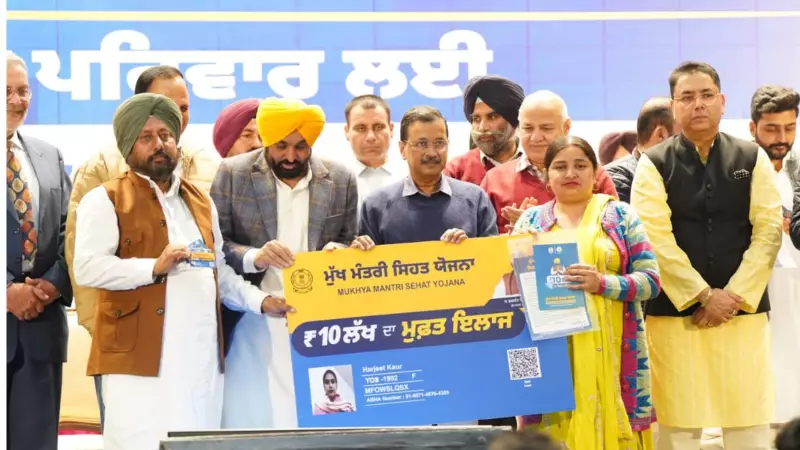
The Aam Aadmi Party-led Punjab government has officially rolled out its flagship universal healthcare initiative, the Mukh Mantri Sehat Yojana (MMSY), promising comprehensive medical coverage to all residents. This ambitious program aims to provide cashless treatment for over 2,500 medical procedures through an annual insurance cover of Rs 10 lakh per family, potentially benefiting approximately 65 lakh households across the state.
Financial Challenges Loom Large
Despite the government's enthusiastic promotion of MMSY as a transformative public health breakthrough, significant financial concerns shadow the scheme's implementation. Punjab currently grapples with a staggering debt burden of Rs 4 lakh crore for the 2025-26 fiscal year, raising questions about the sustainability of such an extensive welfare program. The state administration has allocated just Rs 1,200 crore in its budget for this initiative, a figure that healthcare experts and opposition parties argue may prove insufficient.
The scheme operates on a hybrid funding model where the central government's United India Insurance Company covers Rs 1 lakh per family annually, while the Punjab government assumes responsibility for the remaining Rs 9 lakh. This structure essentially functions as a state-funded reimbursement system rather than a conventional insurance program, placing substantial financial liability on the already debt-ridden state exchequer.

Past Payment Issues Raise Red Flags
Skepticism surrounding MMSY's financial viability stems from recent history. During 2024-2025, private hospitals represented by the Private Hospital and Nursing Home Association (PHANA) suspended cashless treatments under Punjab's previous health insurance scheme due to approximately Rs 600 crore in pending government dues. The matter reached the Punjab and Haryana High Court, which issued notices to both state and central authorities in December 2025 regarding systematic payment delays.
Healthcare professionals familiar with the state's medical infrastructure express concern about cost escalation. "Given that the scheme covers more than 2,300 treatment packages, including expensive procedures such as cancer therapy, cardiac surgeries, organ transplants and ICU care, the eventual burden could be significantly higher," noted a hospital administrator who requested anonymity. The universal nature of the program makes accurate cost prediction particularly challenging.
Political Dimensions and Opposition Criticism
With the 2027 Assembly elections approaching, the political undertones of MMSY are unmistakable. Chief Minister Bhagwant Mann and AAP national convener Arvind Kejriwal launched the scheme at a public gathering in Mohali, positioning it as a cornerstone of their governance model that mirrors Delhi's emphasis on free healthcare and education. Kejriwal emphasized the inclusive nature of the program, stating it would benefit all residents regardless of political affiliation.
However, opposition parties have launched scathing critiques. Shiromani Akali Dal leader N K Sharma accused the government of misleading the public, claiming that genuine implementation would require a budgetary allocation closer to Rs 10,000 crore rather than the current Rs 1,200 crore provision. Sharma characterized the scheme as primarily a "publicity gimmick" ahead of elections, arguing that the actual insurance coverage amounts to just Rs 1 lakh per family with the government promising to cover remaining claims.
Replacing Previous Systems
MMSY replaces Punjab's earlier health insurance scheme that provided Rs 5 lakh annual coverage per family through a 60:40 funding arrangement between central and state governments. The previous program served 15 lakh beneficiaries exclusively from families in the bottom 40% income bracket, whereas the new initiative adopts a universal approach without income restrictions.

As awareness about MMSY grows and enrollment potentially increases in coming months, the Punjab government faces the dual challenge of managing rising healthcare demands while addressing its substantial debt burden. The success of this ambitious health coverage scheme will depend heavily on efficient implementation and sustainable financial management in a state already facing significant economic pressures.