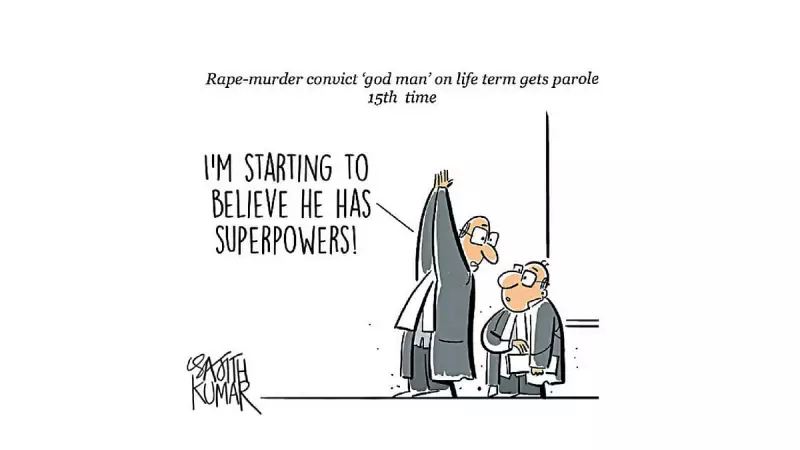
A recent editorial cartoon published by Deccan Herald has ignited conversations around the enduring influence of self-styled spiritual leaders, often referred to as 'godmen,' in Indian society. The artwork, created by renowned cartoonist Satish Acharya, employs sharp satire to question the extraordinary claims and perceived 'superpowers' frequently attributed to such figures.
The Cartoon's Stark Commentary
The cartoon presents a critical visual narrative that holds up a mirror to a segment of society and its mechanisms of belief. Without reproducing the image, the essence of the commentary is clear: it challenges the blind faith and unquestioning devotion that often surrounds charismatic individuals who claim divine or supernatural abilities. Acharya's work subtly points to the disparity between these proclaimed powers and the tangible realities faced by common people.
The cartoon serves as a social critique rather than targeting any single individual, focusing on the broader phenomenon. It underscores how these figures sometimes amass significant wealth, political patronage, and a cult-like following, all while their 'miracles' remain unverified by any rational or scientific scrutiny. The timing of such cartoons often coincides with public controversies or legal cases involving prominent godmen, prompting media and public discourse.
Satish Acharya's Legacy of Social Satire
Cartoonist Satish Acharya is well-known for his incisive and fearless commentary on political and social issues. His work regularly features in national and international publications, using humor and irony to dissect complex topics. This particular cartoon on godmen fits squarely within his oeuvre of challenging powerful institutions and societal norms.
Through his art, Acharya invites readers to engage in critical thinking. He does not merely mock; he prompts a reflection on why such figures gain immense popularity. The cartoon implies a societal vulnerability—a search for hope, solutions to life's problems, or spiritual comfort—that can be exploited by those claiming extraordinary gifts. The visual satire acts as a catalyst for debate on rationality, faith, and the need for public accountability.
Broader Implications and Public Discourse
The publication of this cartoon in a major newspaper like Deccan Herald highlights the media's role in questioning and investigating influential entities. It contributes to an ongoing national conversation about the intersection of faith, fraud, and fame in modern India. Numerous high-profile cases in recent years have seen godmen facing serious legal charges, ranging from financial fraud to sexual assault, making Acharya's satire particularly resonant.
Public reaction to such cartoons is typically divided. While some applaud the artist for bold criticism and defending rational thought, others may view it as an attack on personal religious beliefs and cultural traditions. This dichotomy itself is a testament to the complex space godmen occupy in the Indian socio-religious landscape. The cartoon, therefore, is not just a piece of art but a commentary on the ongoing tension between blind devotion and skeptical inquiry.
In conclusion, Satish Acharya's cartoon for Deccan Herald is a significant piece of contemporary editorial commentary. It successfully uses the power of visual satire to question the unchecked authority and alleged superpowers of self-proclaimed godmen, encouraging the public to look beyond the spectacle and demand greater transparency and rationality. In doing so, it reinforces the crucial role of a free press and artistic expression in fostering a healthy, questioning democracy.