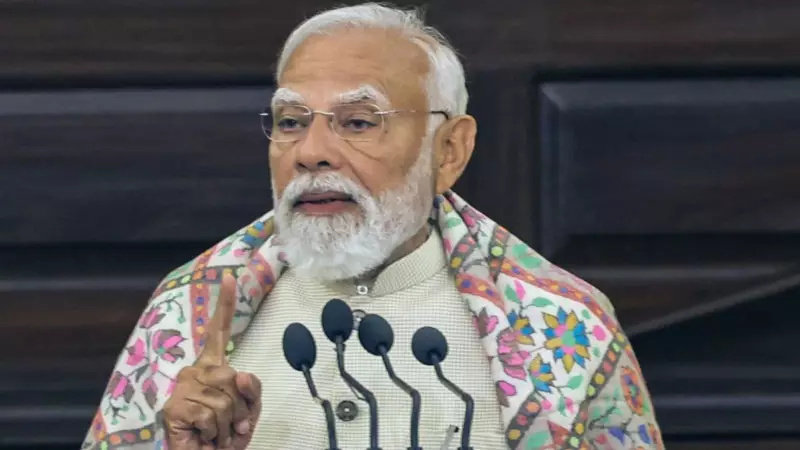
Prime Minister Narendra Modi delivered a powerful address at the 28th Conference of Speakers and Presiding Officers of the Commonwealth in New Delhi on Thursday. He declared that in India, democracy truly delivers results for its people.
Transforming Diversity into Democratic Strength
Speaking at Samvidhan Sadan, the Prime Minister reflected on India's journey since independence. "When India gained freedom," he said, "many doubted whether democracy could survive amid such immense diversity. But India transformed this very diversity into the bedrock of our democratic success."
He emphasized that India has proven democracy can not only survive but thrive. "Another common doubt was that even if democracy somehow survived in Bharat, it would never achieve development. Today, Bharat stands as the world's fastest-growing economy, demonstrating how democratic institutions provide stability, speed, and scale."

Last-Mile Delivery Defines Indian Democracy
PM Modi presented a clear definition of democracy's success in India. "In Bharat, the definition of democracy is last-mile delivery," he stated firmly. "We work with the spirit of public welfare for each individual without any bias. This approach has lifted 25 crore people out of poverty in recent years."
The Prime Minister explained why democracy works so effectively in India. "Democracy delivers in Bharat because in our country, the people are paramount. We have made their aspirations our priorities. From process to technology, everything has been democratized to ensure no obstacles hinder their progress."
Extraordinary Scale of Indian Democracy
Highlighting the massive scale of India's democratic exercise, PM Modi pointed to the 2024 General Elections. "Many know India as the world's largest democracy," he noted. "The 2024 elections were the largest democratic exercise in human history, with nearly 980 million registered voters. This number exceeds the population of some continents."
He detailed the election's impressive statistics. "There were more than 8,000 candidates and over 700 political parties participating. The elections showed record participation by women voters. Today, Indian women aren't just participating but leading the way. Our President is a woman. The Chief Minister of Delhi, where this conference is happening, is a woman."
The Prime Minister added that in rural and local government bodies, India has about 1.5 million elected women representatives. This represents almost 50 percent of grassroots leaders, an achievement unparalleled globally.
Democratic Roots in Ancient Traditions
PM Modi traced India's democratic traditions back thousands of years. "India's democracy is like a large tree supported by deep roots," he explained. "Our sacred texts, the Vedas, over 5,000 years old, refer to assemblies where people met to discuss issues and took decisions after discussion and agreement."
He continued, "India is the land of Bhagwan Buddha, where the Buddhist Sangha used to have open and structured discussions, with decisions taken through consensus or voting." The Prime Minister also mentioned a 10th-century inscription from Tamil Nadu describing a village assembly that operated with democratic values, complete with clear rules for accountability and decision-making.
"India's democratic values have been tested by time," he asserted. "They have been supported by our diversity and strengthened generation after generation."
Global Leadership and Achievements
The Prime Minister highlighted India's global contributions and domestic achievements. He noted that India's UPI has become the world's biggest digital payments system. The country stands as the world's largest vaccine producer, second-largest steel producer, and hosts the third-largest startup ecosystem and aviation market globally.
India also boasts the fourth-largest railway network and third-largest metro rail network worldwide. It remains the biggest milk producer and second-largest rice producer on the planet.
PM Modi recalled India's response during the Covid-19 pandemic. "When the entire world was struggling," he said, "India supplied medicines and vaccines to more than 150 nations. Serving people's interests, welfare, and well-being is India's ethos, nurtured by our democracy since time immemorial."

Championing the Global South
Addressing geopolitical challenges, the Prime Minister emphasized India's role in representing developing nations. "Nearly 50 percent of the Commonwealth's total population resides in India," he pointed out. "India has consistently sought to contribute as much as possible to the development of all nations."
He detailed India's commitment to the Commonwealth's Sustainable Development Goals. "Whether in health, climate change, economic growth, or innovation, India is fulfilling its commitments with full responsibility. We continuously learn from fellow partners while ensuring India's experiences benefit other Commonwealth nations."
"When the world is undergoing unprecedented transformation," PM Modi continued, "it is also the moment for the Global South to chart new pathways. India is strongly voicing the concerns of the Global South at every global platform. During our G20 Presidency, we placed these concerns at the center of the global agenda."
Historic Venue and Democratic Legacy
The Prime Minister noted the significance of the conference venue. Samvidhan Sadan, formerly the Old Parliament building, holds immense importance in India's democratic journey. "It was here in the Central Hall," he explained, "during the final years of colonial rule when India's freedom was certain, that the Constituent Assembly met to draft our Constitution."
"For 75 years after Independence," he added, "this very building served as India's Parliament, witnessing numerous crucial decisions and discussions that shaped our nation's future. We recently celebrated 75 years of implementing our Constitution."
Conference Details and Participation
The 28th CSPOC, chaired by Lok Sabha Speaker Om Birla, brings together 61 Speakers and Presiding Officers from 42 Commonwealth countries and 4 semi-autonomous parliaments worldwide. This marks the fourth time India has hosted this important conference.
Delegates will deliberate on contemporary parliamentary issues including the role of Speakers in maintaining strong democratic institutions, the use of Artificial Intelligence in parliamentary functioning, and the impact of social media on Members of Parliament.
Prominent attendees included Rajya Sabha Deputy Chairman Harivansh, President of Inter Parliamentary Union Dr Tulia Ackson, and Dr Christopher Kalila, chairperson of the Commonwealth Parliamentary Association.