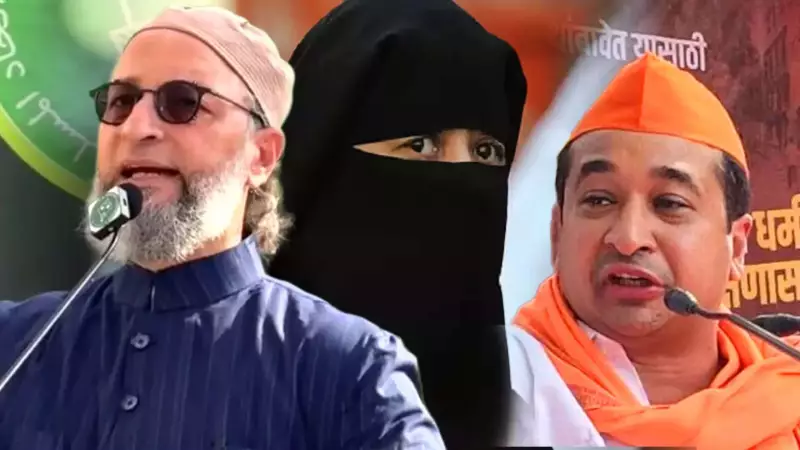
A political firestorm erupted after All India Majlis-e-Ittehadul Muslimeen (AIMIM) president Asaduddin Owaisi suggested that India could one day see a woman wearing a hijab as its Prime Minister. The remark, made at a public rally in Solapur on January 10, 2026, drew immediate and sharp condemnation from the Bharatiya Janata Party (BJP), with Maharashtra minister Nitish Rane asserting India's identity as a Hindu nation.
The Controversial Statement and Constitutional Contrast
Addressing supporters, Asaduddin Owaisi highlighted the secular framework of the Indian Constitution. He contrasted it with the constitutional provisions in Pakistan, noting that India places no religious restrictions on holding the highest constitutional offices, including that of the Prime Minister. Owaisi credited this foundational principle of inclusivity and equal opportunity to the vision of Dr. B.R. Ambedkar.
His specific comment that sparked the row was the possibility of a hijab-clad woman ascending to the prime ministerial position, underscoring the constitutional promise that any citizen, irrespective of religion or attire, can aspire to lead the country.

BJP's Forceful Rejection and Counterattack
The reaction from the BJP was swift and unequivocal. Maharashtra Minister and BJP leader Nitish Rane outrightly dismissed Owaisi's statement. In his retort, Rane emphasized that India is a Hindu nation and opposed the idea of women wearing hijabs or burqas holding key political posts.
Adding another layer to the party's response, BJP national spokesperson Shehzad Poonawala challenged Owaisi on his own party's practices. While acknowledging that the Constitution indeed allows anyone to become Prime Minister, Poonawala questioned Owaisi's commitment to inclusivity within his own organization. He specifically called on the AIMIM chief to first promote women and Pasmanda Muslims (backward classes among Muslims) to leadership positions within the AIMIM before making broader national statements.
Political Implications and Deepening Divides
This exchange has quickly escalated into a major political controversy, reigniting debates on secularism, national identity, and religious symbolism in public life. Owaisi's comments are seen as an assertion of constitutional secularism and the rights of religious minorities. In contrast, the BJP's response, particularly Rane's 'Hindu nation' assertion, reinforces the party's majoritarian political stance.
The incident underscores the deep ideological chasm between parties like the AIMIM and the BJP. It also shifts focus to internal diversity within Muslim political representation, as highlighted by Poonawala's mention of Pasmanda Muslims. This war of words is likely to fuel further political discourse in the lead-up to future elections, keeping issues of religious identity and constitutional morality at the forefront of national politics.