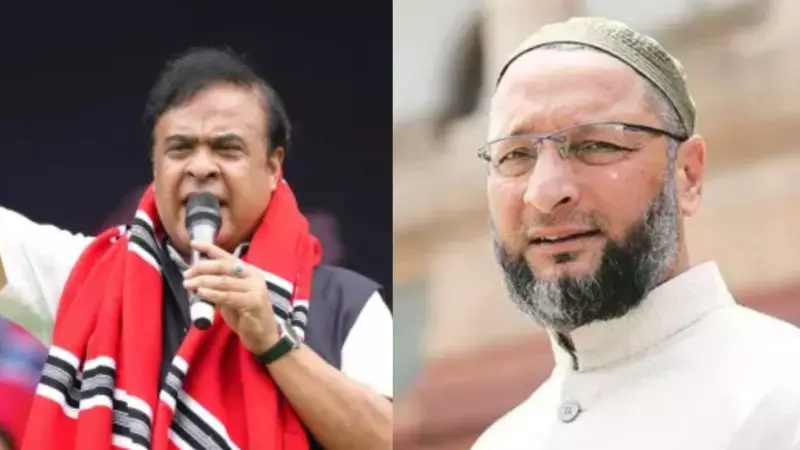
A significant political debate has been ignited following a remark by All India Majlis-e-Ittehadul Muslimeen (AIMIM) president Asaduddin Owaisi about the future of India's leadership. The controversy has drawn a sharp response from Assam Chief Minister Himanta Biswa Sarma, leading to a public exchange that touches on constitutional principles, religious identity, and national politics.
Owaisi's Vision at Solapur Rally
On Friday, January 10, 2026, while addressing an election rally in Solapur, Maharashtra, Asaduddin Owaisi made a statement that quickly captured national attention. Citing the foundational principles laid down by Dr. B.R. Ambedkar, Owaisi emphasized that the Indian Constitution guarantees equal opportunity to every citizen.
He asserted that the constitution allows any Indian citizen to aspire to and hold the highest constitutional offices, including that of the Prime Minister, Chief Minister, or mayor. To underline his point, Owaisi drew a contrast with neighboring Pakistan, claiming its constitution does not offer a similar level of inclusivity for people belonging to religions other than Islam.

"It is my dream that a day will come when a hijab-clad daughter becomes the Prime Minister of this country," Owaisi declared, framing his comment as both a testament to India's constitutional promise and a personal aspiration.
Himanta Biswa Sarma's Firm Rebuttal
The reaction from Assam's Chief Minister, Himanta Biswa Sarma, was swift and unequivocal. Sarma criticized Owaisi's statement, presenting a counter-narrative focused on India's civilizational identity.
While Sarma acknowledged the constitutional position, stating, "Constitutionally, there is no bar on anyone becoming the Prime Minister," he immediately followed it with a strong assertion of his belief. "But India is a Hindu nation... I believe the Prime Minister of India will always be a Hindu," Sarma stated, clearly delineating between the legal framework and his perception of the country's socio-political reality.
This response highlights a recurring tension in Indian political discourse: the distinction between the secular guarantees of the constitution and the majoritarian cultural sentiments often expressed in the public sphere.
Analyzing the Core of the Debate
This exchange between the two leaders is more than a war of words; it underscores a fundamental debate about India's identity. Owaisi's remark was strategically aimed at highlighting the pluralistic and non-discriminatory ideals enshrined in the constitution. By mentioning Pakistan, he positioned India's legal framework as superior in its treatment of religious minorities.
On the other hand, Himanta Biswa Sarma's retort reflects a perspective that views India's essence as inherently Hindu, suggesting that its top political leadership is expected to emerge from the majority community. This viewpoint, while respecting the constitutional right of all citizens to contest for power, asserts a dominant cultural and political expectation.
The incident, occurring in January 2026, adds another layer to the ongoing political narratives as the country navigates its complex social fabric. It brings to the forefront questions about representation, secularism, and the practical interpretation of constitutional rights in a diverse democracy.
Ultimately, the debate encapsulates two powerful visions for India: one that sees the nation's strength in its unwavering constitutional commitment to equality, and another that roots its future in a majoritarian cultural ethos. The discussion is likely to resonate in political circles and public discourse for the foreseeable future.