The Election Commission of India has presented startling evidence to the Supreme Court about serious irregularities in West Bengal's voter lists. For several past elections in the state, hundreds of voters have recorded the same individual as their father, creating massive logical discrepancies that demand immediate correction.
Shocking Cases of Multiple Paternity Claims
In a detailed affidavit submitted on Monday, the Election Commission revealed extreme cases where single individuals appear as parents to hundreds of voters. The most striking example comes from assembly constituency number 283 in Barabani, Asansol district. Here, one person has been officially registered as the father of 389 different voters in the 2025 electoral list.
Another alarming case emerged from constituency number 169 in Bally, Howrah district. In this instance, a different individual is recorded as the father of 310 separate voters. These numbers far exceed any reasonable biological possibility and point to systematic errors or potential manipulation in voter registration processes.

Widespread Pattern of Discrepancies
The Election Commission's data paints a concerning picture across West Bengal. According to their analysis, seven different people are linked to more than 100 voters each as parents. Ten individuals have been recorded as parents of 50 or more voters, while another ten appear as fathers to 40 or more voters.
The pattern continues with fourteen more people listed as fathers of 30 or more voters. Fifty individuals are connected to more than twenty voters each. The scale becomes even more apparent with 8,682 people recorded as parents to more than ten voters each. An astonishing 2,06,056 individuals appear as parents to more than six voters, and 4,59,054 people are linked to more than five voters each.
EC Counsel Explains the Statistical Impossibility
Rakesh Dwivedi, counsel for the Election Commission, presented these findings before a bench comprising Chief Justice Surya Kant and Justices Dipankar Datta and Joymalya Bagchi. He emphasized how these numbers contradict established demographic patterns in India.
"According to the National Family Health Survey 2019-21, the average household size in India is 4.4," Dwivedi told the court. "This indicates that on average, each family consists of just 2-3 children. However, we're seeing cases where more than fifty electors link themselves to one parent. These cases absolutely require clarification from the voters involved."
Systematic Verification Process Initiated
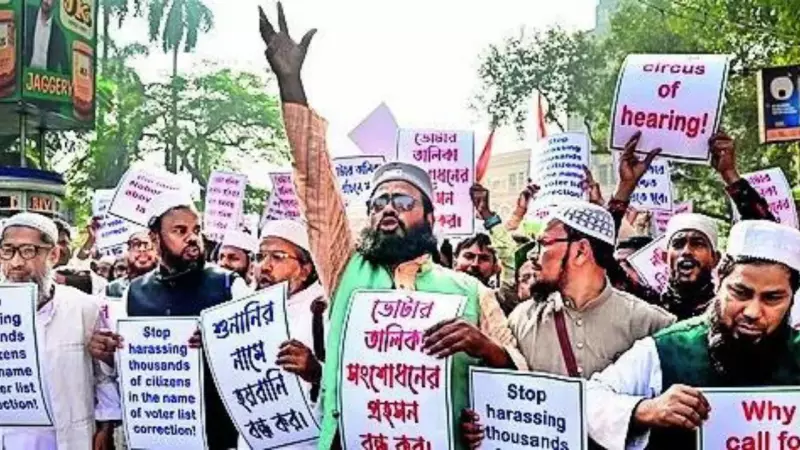
The Election Commission has categorized these irregularities as 'logical discrepancies' that must be corrected. Notices have been issued to affected voters, placing the responsibility on them to produce documents proving their correct parental information.
"Cases where six or more electors have mapped themselves to one person deserve greater scrutiny regarding the validity of these linkages," the Election Commission stated. "Electoral registration officers are issuing notices to verify whether matching has been done correctly, eliminating any chance of fraudulent mapping."
Four Additional Grounds for Scrutiny
Beyond the multiple parent-child linkages, the Election Commission has identified four more categories triggering notices under the 'logical discrepancy' classification:
- Names of electors in the current roll (as of October 27, 2025) that don't match their names in the 2002 State Identification Register roll
- Age differences between electors and their parents (calculated from 2002 SIR data) that are less than fifteen years
- Age differences between electors and their parents (from 2002 SIR data) that exceed fifty years
- Age differences between electors and their grandparents that are less than forty years
These additional criteria help identify other types of inconsistencies that could indicate errors or deliberate falsification in voter registration records. The comprehensive approach demonstrates the Election Commission's commitment to cleaning up electoral rolls and ensuring their accuracy before future elections.

The Supreme Court hearing highlights ongoing challenges in maintaining accurate voter databases in India, particularly in states like West Bengal where electoral competition remains intense. The revelations about hundreds of voters sharing the same registered father raise serious questions about the integrity of past electoral processes and the need for robust verification mechanisms moving forward.