NEET-UG Re-Exam: Physics Section Deemed Toughest
The NEET-UG re-examination, conducted on June 21, 2026, tested students' endurance and conceptual depth, with the physics section being particularly lengthy and time-consuming. According to Vivek Thakur, an IIT-Kharagpur alumnus and managing director of Scholars Den, the physics section was extremely difficult for students to complete within the allotted one hour. He stated that even some easy questions involved reading a large volume of text, making quick solving challenging. Thakur noted that scoring above 120 out of 180 in physics would be considered exceptional, as only 3-4 questions were straightforward read-and-tick types.
Impact on Cut-Off Marks
Thakur explained that physics plays a major role in determining NEET-UG ranks, and the lengthy, calculative paper is expected to lower cut-offs considerably. He predicted that the general category cut-off for government medical colleges could drop to sub-550 marks. Referring to the 2025 NEET-UG paper, which had similar physics toughness and saw cut-offs fall to 525, Thakur said that except for the top 100 ranks, scoring close to 120 marks in physics would be exceptional.
Nabin Kaarki, national academic director (medical) at Aakash Educational Services Limited, compared the re-exam to the May 3 session, which rewarded straightforward NCERT textbook review. He said the new test demanded rigorous analytical preparation over quick memory recall. Kaarki classified the overall paper as moderate to difficult, more demanding than the initial May session. He noted that physics, driven by core mechanics, electrodynamics, modern physics, and thermodynamics, was the toughest and lengthiest segment. Application-driven numerical problems created intense time pressure.

Chemistry and Biology Analysis
Kaarki observed that chemistry was noticeably tougher than the May 3 exam, while biology (botany and zoology) remained the easiest and highest-scoring section. Vivek Jha, a NEET aspirant from Kota, confirmed that physics was the toughest, chemistry was moderate, and biology was easy. Kaarki predicted that due to restrictive calculation demands in physics and chemistry, along with localised subject ambiguities, the All-India Quota (AIQ) general category cut-off for government seats would experience a downward correction, settling at 590–600 marks.
Impersonation Arrests in Bihar
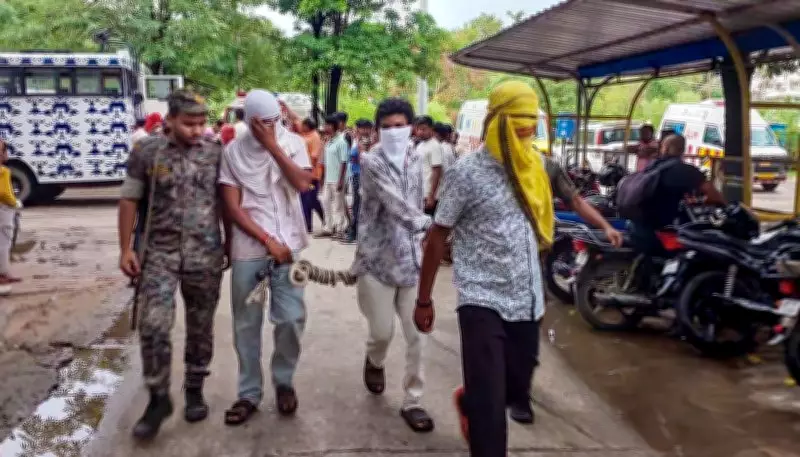
On June 21, Bihar Police arrested 30 suspects, including nine impersonators caught at exam centres in Lakhisarai during the NEET-UG re-examination. All nine impersonators were medical students. According to police, they used fake Aadhaar cards and other documents to enter three examination centres. The arrested impersonators include Saurabh Jijha (AIIMS Raebareli, fourth-year MBBS), Mantosh Kumar (New Jalpaiguri Medical College, fourth-year MBBS), Vivek Kumar (Anugrah Narayan Magadh Medical College, fourth-year MBBS), Himanshu Kumar (Government Medical College Satna, first-year MBBS), Aman Agrawal (University College of Medical Science Delhi, MBBS intern), Jitendra Kumar (Nalanda Medical College, first-year MBBS), Chanchal Kumari (Government Ayurvedic College Odisha, BAMS student), Poonam Kumari (Banaras Hindu University, BSc Nursing), and Roshan Kumar (NMCH Patna, B. Pharma fourth year).
Police also arrested one original examinee, two associates, and 18 biometric staff members, totalling 30 accused. The police suspect the principal organiser of the solver gang network is Arpit Raj, an MBBS student previously questioned by the CBI during the 2024 NEET paper leak probe. In March, the Bihar Economic Offences Unit had arrested Praveen Kumar Sinha alias Dablu Mukhiya, a Lakhisarai resident. Investigation is ongoing into unfair practices in the medical entrance examination.