Navi Mumbai Civic Elections Resume After More Than a Decade
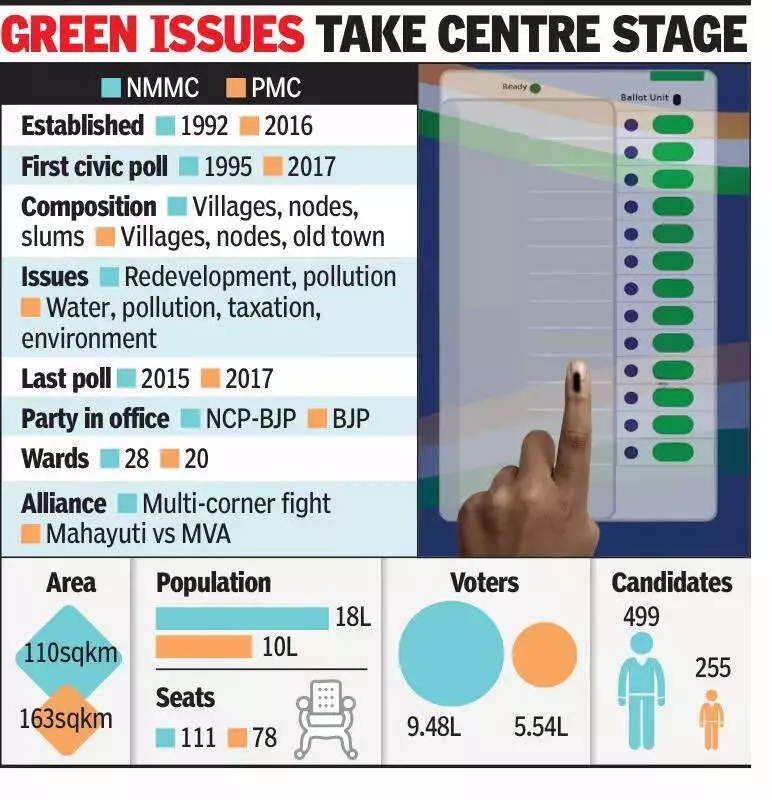
Navi Mumbai finally sees civic polls after a gap exceeding ten years. The Covid-19 pandemic disrupted the last scheduled election in 2020, causing this significant delay. Voters now head to the polls in a charged political atmosphere.
Political Heavyweights Clash in a Two-Way Fight
The election battle essentially narrows down to two dominant figures: archrivals Ganesh Naik and Eknath Shinde. Despite apparent support from top leadership, Mahayuti allies BJP and Shiv Sena failed to form a coalition. This failure ignited a fierce contest between them.
Ganesh Naik has controlled the city since its inception. He consistently retained power while switching affiliations across Shiv Sena, NCP, and now BJP. Naik denied more seats to Shiv Sena, which requested 57. Eknath Shinde refuses to accept Naik's decades-long dominance. Shinde actively instructed cadres, including Thane MP Naresh Mhaske, to dethrone Naik and capture the mayor's post.

Historical Context and Current Alliances
In the 2015 polls, the undivided Shiv Sena finished second with 38 corporators. The Naik-led NCP secured 52 corporators, backed by 10 Congress members and five independents. BJP won only six of the 111 seats at that time.
Ganesh Naik and his corporators joined BJP from Sharad Pawar's NCP in 2019. For the current election, BJP fields candidates from all 111 seats. Shiv Sena contests from 105 seats.
BJP's campaign is led by former Thane MP Sanjeev Naik. His brother, two-time Airoli MLA Sandeep Naik, rejoined the party after spending over a year in NCP (SP).
MNS and Shiv Sena (UBT) formed an alliance for these polls. Uddhav Thackeray's party contests 56 seats, while Raj Thackeray's MNS contests 25 seats. MNS's Navi Mumbai chief Gajanan Kale expressed confidence, stating they have a better chance to muster good votes.
Dynastic Politics and Key Electoral Battles
The election prominently features dynastic politics. Multiple leaders fielded their relatives as candidates. Political observers flagged key contests in areas like Digha and Vashi. They also noted that money could play a crucial role, particularly in slum pockets and villages.
New Multi-Member Panel Voting System Debuts
For the first time, Navi Mumbai conducts polls using a multi-member panel system. Voters in wards 1 to 27 will cast a single vote for four seats labeled A, B, C, and D. Voters in ward 28 will vote once for three seats: A, B, and C.
Environmental Issues Shape Voter Concerns
Environmental problems significantly influenced the election discourse. B N Kumar, director of NGO NatConnect Foundation, highlighted that air pollution has become an annual phenomenon. He pointed out that dust control norms are routinely ignored.
Activist Madhu Shankar cited issues like open dumping in Koparkhairane and Sanpada. Gen Z activists, collaborating with NatConnect under the Urvari initiative, formed a human chain at Vashi's mini seashore. They petitioned the Navi Mumbai Municipal Corporation (NMMC) and the Maharashtra Pollution Control Board.
NMMC responded by stating that monitoring devices were installed at 30 sites. They formed flying squads and took actions including advisory letters, show-cause notices, stop-work orders, and fines. Activists criticized these measures as delayed and insufficient.
Open Space Deficits and Urban Planning Challenges
Despite having 232 gardens and 91 playgrounds, Navi Mumbai's per capita open space is only about 3 square meters. This figure falls below WHO norms and the AMRUT mission's recommendation of 9-10 square meters. Activist Vishnu Joshi argued that Cidco auctions have further eroded open spaces.
NatConnect advocated for the use of recycled water. Activists urged voters to demand clean air, safe water, and liveable green spaces from their elected representatives.
The Navi Mumbai civic polls represent a critical moment for the city's governance. Voters decide not only on political leadership but also on addressing pressing environmental and urban challenges.