President Murmu's Bengal Visit Ignites Political Firestorm Over Protocol and Venue
President Droupadi Murmu's attendance at the International Santal Conference in north Bengal on Saturday has erupted into a major political controversy, centering on protocol breaches and alleged political maneuvering. The President highlighted the absence of Chief Minister Mamata Banerjee and her cabinet ministers to receive her in Siliguri, and expressed displeasure over the venue being shifted to a remote location.
Murmu Expresses Disappointment Over Absence and Venue Change
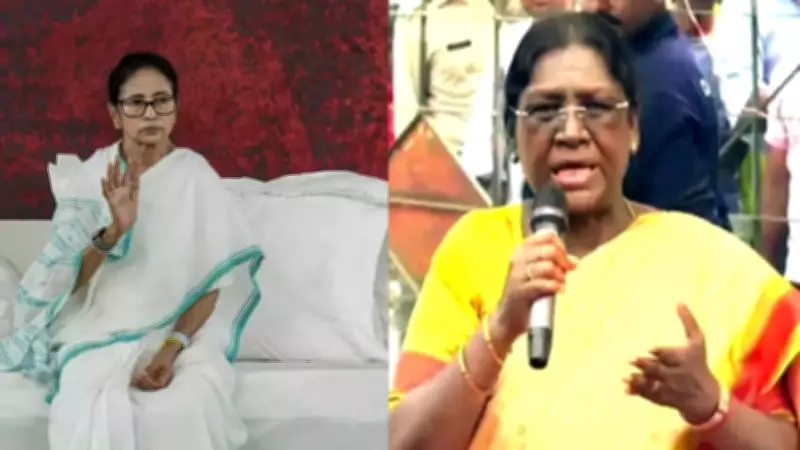
At the event, President Murmu remarked, "Generally, when the President is coming, the CM should be welcoming, and other ministers should be present. But she did not come. The governor has changed and could not come. But because the date was fixed, I have come." She further noted, "When I was coming here to this international conference, I realised that someone was not willing for this meeting to take place. It seems some do not want the Santhals to progress, to learn, and to unite."
The President also observed Santhals apparently being kept outside the venue, stating, "Sitting here, I saw some Santhals roaming outside, as if they were not being allowed to come in. I am also a daughter of Bengal, but they do not allow me to come."

Mamata Banerjee Denies Protocol Breach, Accuses BJP of Misusing Presidency
In response, Chief Minister Mamata Banerjee firmly denied any protocol breach. She asserted that the President was received and seen off by the mayor and police commissioner of Siliguri and the DM of Darjeeling "as per the approved line-up shared by the President's secretariat." Banerjee clarified that the Bengal CM "was not part of the line-up or dais plan" of the private event.
However, Banerjee launched a sharp attack, accusing the BJP of "misusing the highest chair in the country" and dragging the President into politics. She stated, "It's unfortunate that politics is being played by using the President on the advice of BJP and by alleging that no work has been done for tribals. I feel ashamed to even say this. We respect the Hon'ble President. But, she too, has been sent to sell politics."
Banerjee also questioned the President's silence on atrocities against tribals in Manipur and Chhattisgarh, while listing her government's welfare measures for tribal communities, particularly in the Jangalmahal region. She highlighted the official recognition given to the 'Ol Chiki' script for the Santhali language and its introduction in education and competitive examinations.
PM Modi Condemns Bengal Government, Defends Presidential Office
Prime Minister Narendra Modi entered the fray, strongly condemning the Mamata administration. On social media platform X, he wrote, "This is shameful and unprecedented. The pain and anguish expressed by Rashtrapati Ji, who herself hails from a tribal community, has caused immense sadness in the minds of the people of India.... TMC govt has truly crossed all limits. Their administration is responsible for this insult to the President."
Modi emphasized, "The office of the President is above politics and the sanctity of this office should always be respected." He accused the Mamata administration of "truly crossing all limits" and "insulting" the President.
Background and Implications
The controversy unfolded as President Murmu, the first tribal woman to hold the office, visited north Bengal for the International Santal Conference. Originally, Governor C V Ananda Bose was to receive the President, but he resigned on Thursday, adding to the logistical complexities.
This incident has escalated tensions between the Trinamool Congress and the BJP, with both sides leveraging it for political advantage ahead of upcoming elections. The focus on tribal welfare and protocol has become a flashpoint in the ongoing political rivalry in West Bengal.
The exchange underscores the delicate balance between constitutional propriety and political posturing, with the President's office becoming a central figure in the dispute. As the situation develops, it remains to be seen how this will impact tribal politics and inter-governmental relations in the state.